
Home > Camino de Santiago Guide > Which Camino To Choose?
Which Camino to Choose: Comparing Routes to Santiago
Some of my links may be affiliate links. If you make a purchase, I might earn a small commission at no cost to you. See our Privacy Policy for details. And this post was crafted with care and occasional typos by Colleen (and not AI)
You are either planning your very first Camino, or you’ve walked one or two and you’re ready for your next challenge. But how do you choose the route that works best for you?
There are many, many roads to Santiago — each with its own unique flavour, scenery, and history. I’ve walked a fair few over the years, and I still have a long list of routes I’d love to explore… and quite a few I’d happily walk again!

Why Is Choosing the Right Camino Important?
I’m lucky — I live in France, I’m retired, and getting to the Camino is easy for me. In fact, I live along the Vézelay route, and I see Camino arrows and markers every time I pop into town.
But for most pilgrims, planning to walk the Camino is a big undertaking — often a once-in-a-lifetime journey. And if this is your one big Camino, you want it to be everything you’ve dreamed of. And choosing the right route is a huge part of that.
I’ve walked over 20 Camino and I’m already planning the next. But if you’ve only got one shot at this glorious pilgrimage, then you need to feel confident that the route you choose to walk is right for you.
All of these (and more) will help shape the Camino that suits you best.

Most Popular Camino de Santiago Routes
The Camino de Santiago criss-crosses its way across Europe, and there are so many routes to choose from. When I first walked, I thought the Camino Frances was the Camino — I had no idea there were other options!
Thankfully today there is a lot more information on line and it’s also easy to see which routes are the most popular — the Pilgrim Office in Santiago collects and publishes data every year. You can browse it directly on their website, but here’s a quick look at the 2024 numbers.
It’s clear the Frances still tops the list, followed closely by the Portuguese routes. But the Camino Ingles, Primitivo, and Norte are also very popular — and growing every year.
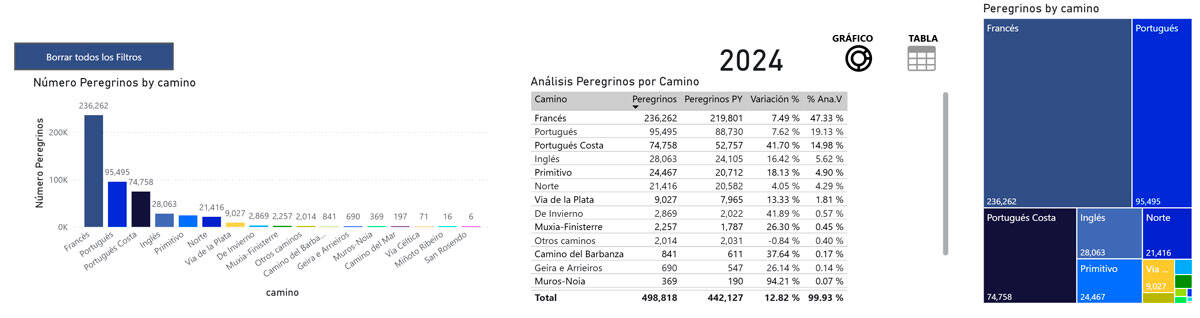
Top Tip : Remember that these figures only show pilgrims who collected a Compostela in Santiago. Many other walk without reaching Santiago or collecting a Compostela.
The Different Camino de Santiago Routes
What is the difference between these routes — and how do you choose the right one for you?
Well, the first thing is to decide what you want from your Camino. What kind of experience are you looking for? And just as importantly — how much time and budget do you have to walk?
Do you want to finish in Santiago de Compostela? Are you drawn to the coast, the mountains, the history, or the solitude? Are you happy to walk in stages and planning to return each year to finish?
I’ve created a workshop about choosing the right Camino. It walks you through the decision making process step by step — but in the meantime, here’s a helpful comparison of some of the many beautiful routes to Santiago.
Not sure which Camino is right for you?
My online workshop walks you through the decision making process step by step — I include route comparisons, reflection prompts and bonus planning tips in detail. All which help you decide which is the right Camino for you!
1. Camino Frances: The Classic Camino Route
The Camino Frances is the route most people imagine when they think of the Camino. It starts in the French border town of Saint-Jean-Pied-de-Port and travels west across northern Spain, through the Pyrenees, Navarra, La Rioja, Castilla y León, and finally into green Galicia.
Along the way, it passes through some of Spain’s most beautiful historic towns – Pamplona, Logrono, Burgos, León, and Astorga, each with its own stunning cathedrals and pilgrim history. You’ll also walk through rural villages, wheat fields, over mountains and along woodland paths.
The Camino Frances is steeped in history – it became the most important medieval pilgrimage route across Europe, used by kings, saints, and common folk alike. It’s also one of the most well marked and most developed, with a wide range of accommodation to suit all budgets.
You’ll find a strong sense of Camino community – walkers from around the world meet, often forming lasting friendships. If you’re hoping for a blend of reflection, history, culture, and social connection, this is the route that offers it all.
The walk itself is not technical, but you’ll need to be prepared for a few mountain stages and challenges and if you’re walking the entire route, the number of walking days will be a challenge. In winter, late autumn and early spring, the mountain passes can be closed and in summer the heat on the Meseta can be difficult.
However, for many pilgrims, the Camino Frances is glorious – I’ve walked it many times so I guess I count myself amongst those too.

2. Camino Portuguese Coastal Route : Stunning Wild Coastal Paths
This was my third different Camino (after two Camino Frances and the Via de La Plata) and since that first time, I’ve gone back to the coast time and time again. The Portuguese Coastal Route is a stunning alternative for pilgrims who dream of walking beside the sea. It’s an easier hike than the much hillier Norte and starts in the vibrant and colourful city of Porto.
The path follows the Atlantic coastline northwards, hugging beaches, promenades, and fishing villages before turning inland toward Santiago after Vigo where it joins the Central route.
It’s a relatively young route in terms of popularity, but not historically and it’s growing fast – for good reason.
The way is well-marked but before Spain, for the most part you keep the sea to your left and keep walking. It’s peaceful, and full of beauty: think salt air, boardwalks, and beach cafés. You’ll also pass through small towns in northern Portugal and Spain, with lovely local food.
The last time I walked I noticed an uptick in pilgrim numbers but this also brings new services.
This is also one of the more accessible options out of Porto but don’t be fooled that there are no hills. They are there but not in the first couple of days.
If you have time, many pilgrims combine the Coastal with the Spiritual Variant or switch to the Central Route at Caminha and head to Valenca and Tui – there’s plenty of flexibility depending on time, energy, and what you prefer.

Want to learn more about the Camino? Then hop over to my Free Private Facebook Group | Walking The Camino De Santiago.
3. Camino Portuguese Central Route: Rural Portugal & A More Traditional Camino Experience
I come from Devon in the UK and the sea was part of my childhood. For me, the choice of route was always going to be the coastal path but in November 2017 I opted to walk the Central Route and I’ve walked it a few times since.
It is the most traditional path through Portugal to Santiago, and whilst it starts in Lisbon, most pilgrims opt to start from Porto. The route is rural and there are more traditional albergue and monastery accommodation on this path. And for this reason it feels more like the Camino Francés in terms of infrastructure and community.
You do get to walk on a lot of cobbles, which can be hard underfoot and I have to say I never wish to walk our of Porto along this route again! Thankfully you can take a metro out of the city or walk the Coastal route to Matosinhos and Vila do Conde, following the estuary out of Porto.
There are some great little towns to visit and lots of history, Barcelos, Ponte de Lima, Valenca and Tui, all have centuries of pilgrim history.
This is a charming Camino, ideal if you’re short on time. Expect rolling countryside, small farms, and a few lovely pilgrim cafés. The path is well-marked and we found a good mix of solitude and social moments – although I’ve not walked this in peak season so it might be considerably busier.
It’s ideal for first-time pilgrims who are looking for a Camino experience but have just a couple of weeks. It also connects easily to the Spiritual Variant at Pontevedra if you’d like a little of the coastal experience.

4. Starting the Camino Portuguese from Lisbon: The Longer Road To Santiago
Very few pilgrims walk from Lisbon. Gerry and I planned this walk in 2018 and even got our first stamp from the Cathedral and walked most of the first stage out of the city, planning to return. Life challenges prevented the return and we’ve not found the time to return – other routes always seem to call our attention.
It’s certainly a route for pilgrims with the time and stamina, starting the Camino in Lisbon is a a considerable challenge. You’ll walk the full length of the Portuguese Central Route, beginning in Portugal’s fabulous capital before making your way through the heart of the country, and cities such as Coimbra before arriving in Porto.
This route can feel lonely at times and there are a few longer stretches. I’ve also read that some parts follow roads and less-scenic farmland and a fair amount of eucalyptus plantations. That said, you’ll experience genuine hospitality, untouched rural communities, and a real sense of being on an old pilgrimage route.
If you’d like to learn more about this route a good friend of mine walked and charted her progess in her personal blog. It was a few years ago but I’m sure much remains the same and it gives a good insight into the trail.

Rota Vicentina & Fishermen’s Trail
For the truly adventurous, I know that a few pilgrims have walked from further south – by walking the Fishermen’s Trail, part of the Rota Vicentina, from the Algarve and Alentejo coast up to Lisbon.
We walked this trail in 2018, it ended far too quickly after I took a fall but we continued by car to ensure we didn’t miss the end! It’s a glorious trail, we met very few others and it was tough going in places and very hot even in October but nonetheless fabulous.
This isn’t an official Camino route, I’ve read a few pilgrims who have walked from the south and made their own way up the coast to join the Camino in Lisbon. This would certainly be a wild and beautiful way to begin your pilgrimage – not for the faint-hearted, but an unforgettable start if you’ve got time, legs, and a love of rugged coastlines.
There is a really excellent Rota Vicentina website if you’re interested in this trail.

5. Camino Espiritual (Spiritual Variant): Pilgrimage by Land and Sea
The Camino Espiritual, or Spiritual Variant, is a beautiful addition to the Portuguese Camino. Beginning on the outskirts of Pontevedra, this detour winds through the beautiful Salnés valley, with vineyards, sea views, and quiet rural villages, before reconnecting with the main route in Padrón – the town where the body of Saint James is said to have arrived in Spain by boat.
There are a few highlights in this short walk
This is a fabulous addition to either the Central or the Coastal path and if you can spare the time, allow a few extra days and walk this slowly to soak it all in!

6. Camino del Norte: Rugged Coast, Quiet Paths and more than a few hills!
The Camino del Norte was Gerry’s choice for his 60th birthday. He loves the northern coast of spain and this route did not disappoint. But it was a challenge.
Starting from Irún, we took the Alpinista route up and up and up. The views were majestic but oh my it was steep. You follow the sea, going in an out of rural Spain and back to the coast, passing through the Basque Country, Cantabria, Asturias, and finally into Galicia.
You’ll pass through San Sebastián, Bilbao, Santander, Gijón, and Ribadeo –elegant seaside cities, many more fishing villages, and with stunning views of the Picos. It’s a tougher route than the Francés or Portuguese paths: longer distances between services, and frequent elevation changes.
But the rewards are immense – stunning views, hidden beaches, and the chance to experience a very different Camino. We walked this path too quickly and plan to go back one day and take our time, spend a few months slowly exploring this stunning corner of Spain.
You can also divert from the main path as there are a few routes which lead off the Norte :
7. Camino Primitivo: The Original Camino
The Camino Primitivo (or Original Way) is said to be the first Camino. This was the route, taken in the 9th century by King Alfonso II, shortly after the discovery of Saint James’ remains. Starting from Oviedo, it winds its way through the Asturian and Galician mountains, eventually joining the Camino Francés at Melide.
This is a Camino of many hills! And ancient forests, stone villages, and misty valleys. The terrain can be challenging — there are some steep hills and most days you have plenty of elevation and decent. There are also a few longer, remote stretches — but there is no doubt it’s beautiful.
Many say it feels like the Camino Frances, but 20 years ago. There are lots of albergue accommodation and also options for private rooms and you get to walk through the historic city of Lugo.
The infrastructure is improving every year, but this isn’t like the Frances, in that services are well spaced. We took picnics most days and ate on the road. Some planning is needed, especially in high summer when albergues can fill up, or spring when rain can make things tricky underfoot.
The route starts in Oviedo, although we started in Ribadesella and walked in from the coast. Make sure you allow time to visit the stunning San Salvador Cathedral, where medieval pilgrims are encouraged to visit El Salvador the lord and not just his servant Santiago.
This is a route that I know I will walk again but I will choose May as I want to see this glorious landscape in spring green!

8. Camino Inglés: The Sailors’ Route from the North
The Camino Inglés, or English Way, is a short but nonetheless pretty route that was once the primary path for pilgrims arriving by sea from England, Ireland, and northern Europe. Landing at the ports of Ferrol or A Coruña, medieval pilgrims would make their way inland to Santiago to complete their journey. Indeed one of the earliest recorded pilgrimages was along the Ingles so it has a fine historical pedigree.
I held back on walking this route for many years. I’d read it was less attractive and less camino-ey than other routes. Thankfully this was wrong! I loved the route. I loved the coastal path and Betanzos was a glorious surprise. Yes, there was a lot of tarmac but I have walked it since that first time which goes to show how much I loved it!
Today, the path from Ferrol offers just over 100 km of rolling pretty scenery — enough to earn the Compostela. It’s a complete Camino, it’s well-marked, full of charm, and easy to complete in a week. The walk passes through wooded hills, sleepy villages, and small towns like Pontedeume, Betanzos, and Sigüeiro, all offering great camino experience with enough services for any pilgrim
While it doesn’t have the same long-haul feel as the Francés or Portugués, it’s perfect for:
The A Coruña route is even shorter and you can opt to walk at least 25 km of a recognised Camino elsewhere (with stamps) to earn the Compostela. The Celtic caminos in Ireland would be perfect.

9. Camino Finisterre: Walking Beyond Santiago to the end of the world
Before I’d even stepped foot on a Camino trail, I’d walked up to the lighthouse at the end of the world and I’d found my shell on a nearby beach. It was here also that I decided for sure that I would walk the Camino Frances.
I’ve yet to walk to Finisterre or Muxia but I’ve visited both many times over the last decade. Made popular as a destination after the movie The Way, for many pilgrims, it’s a chance to extend the journey — one last walk before going home.
This ancient path follows an old pre-Christian pilgrimage routes west to Cape Finisterre and Muxia, once thought to be the edge of the known world. There are options to break the journey into shorter days and many pilgrims stop in Negreira, Olveiroa, or Cee, before reaching the coast.
At Finisterre, you’ll find the famous lighthouse, a bronze boot sculpture, and the zero kilometre marker. Some pilgrims bring items to burn at sunset — a tradition once common but now very much discouraged due to fire risk — best instead to simply sit quietly and watch the sun set into the sea.
Muxía, a quieter fishing port with it’s ancient Celtic settlements and stunning rocky coastline. I ended my Via de la Plata here amongst the giant rocks beside the Santuario da Virxe da Barca and I’ll admit I sobbed at the prospect of that journey’s end.
This route is about closure and reflection and I’d encourage all pilgrims to find time to visit, even if you don’t walk. And if you do walk, you can request a Fisterrana (certificate of completion) or a Muxiana if you go to both.

10. Vía de la Plata: Spain’s Long Southern Pilgrimage
Walking the Vía de la Plata will for me remain one of the greatest things I’ve done in my life. I loved this trail. It’s not easy and not always pretty but there was something about this path that stole my heart.
It’s one of Spain’s longest Camino routes, stretching from Seville in the south to Santiago de Compostela. It follows the path of an ancient Roman road (hence the name “Silver Route”) through Andalusia, Extremadura, Castilla y León, and finally Galicia. Although, as we walked, we learned the route goes back to Neolithic times.
There is so much history on this trail. It is a Camino of vast skies and long days. Pilgrims pass through ancient Roman cities like Mérida and Salamanca, tiny hamlets, and wide-open landscapes where pigs root under cork oaks and storks nest on church towers. In spring, the fields come alive with colour – wildflowers, poppies, lavender, almond blossom, and butterflies galore and in Autumn expect golds and oranges and yellows and the scent of woodsmoke.
This is not an easy walk and there were many days when we never saw another soul. Accommodation wasn’t always easy and you rarely had a coffee stop enroute. And yet, it remains one of my favourite Camino and I know I will walk it again!
At Granja de Moreruela, you’ll have a choice of continuing north to meet the Camino Frances at Astorga or go northwest along the Camino Sanabrés, which leads directly to Santiago (and is far less travelled).
This is not the ideal route for a first time pilgrim unless you’re an experienced hiker and happy with your own company. And expect some very hot days! But oh boy I loved this walk!

11. Camino Sanabrés: A lesser walked Path Through the Heart of Galicia
- Distance: 365 km (from Granja de Moreruela to Santiago)
- Average Duration: 12–18 days
- Pilgrims in 2024: not listed for the entire route but 4000 pilgrims started in Ourense
- Start: Granja de Moreruela (where it branches from the Vía de la Plata) but many start in Ourense
- Terrain: Rolling hills, forests, farmland, a few steep climbs and very rural
- Difficulty: Moderate – some long hilly stages and rural
- Services: OK – especially from Puebla de Sanabria onwards; but do expect fewer pilgrims
- Best Time to Walk: April–October
- Known For: Quiet trails, wonderful scenery, thermal springs, and a quieter path along the last 100 kilometres into Santiago
- Popular With: Those finishing the Vía de la Plata, and those seeking a quieter final 100 km
We opted for the Camino Sanabres when we walked the Via de la Plata and this was Gerry’s first Camino, although he started in Ourense. It’s a fabulous walk, glorious scenery and certainly a quieter path to Santiago.
This route crosses from the Castilian plains into the lush green hills of Galicia, with a beautiful blend of rural villages, shady forests, and old Roman roads. It offers some surprising highlights along the way — including the castle of Puebla de Sanabria where you have a very nice modern Parador and the beautiful monastery ruins at Oseira which is a memory that I’ll never forget! You can soak in the hot springs of Ourense, and enjoy much quieter paths and a few excellent albergue too.
The stages are hilly but manageable, and you’ll pass through small Galician hamlets with warm very welcomes and hearty food. The Sanabrés is ideal for:

12. Le Puy Route (Via Podiensis): The French Pilgrim’s Path
I live in France but I’ve yet to walk Le Puy Route, known in France as the Via Podiensis. This is the the most popular French pilgrimage route to Spain and begins in the hilltop town of Le Puy-en-Velay,
From there, the path winds through the remote Aubrac Plateau, the Lot and Cele valleys, and the countryside of Gascony and the Pyrenees foothills. You’ll pass medieval churches, Romanesque chapels, chateaux, and cobbled villages that feel like they haven’t changed in centuries.
I have visited so many of these places and walked a few sections of the trail but as yet not the entire route. Mainly because I know it will be quite wet in Spring and I’m often busy in September but one of these days I’ll make this trail!
This route has a strong French pilgrim tradition and very popular with French walkers. The gîte system (small, often family-run pilgrim accommodations) provides evening meals and communal breakfasts, making it a more social affair.
Friends who have walked tell me you can eat well with plenty of cheese, local wine, duck, lentils, and tarte aux pommes — and you’ll walk through some of the most peaceful landscapes in Europe.
This path ends in Saint-Jean-Pied-de-Port and a few hardy pilgrims then make their way onwards to either Roncesvalles or continue to Santiago.
13. Camino Aragonés: A Wild historic Path Over the Pyrenees
The Camino Aragonés is the forgotten sibling of the French routes into Spain — beginning at the Somport Pass. It was once the major medieval entry point into Spain but long forgotten by pilgrims, today it’s a very quiet trail.
We opted for this short walk in 2021 and walked in July which was a mistake as it was just too hot on the Spanish side of the mountains. We opted to walk from Oloron in France and I’d recommend this as it’s beautiful. We also diverted to the Monastry at Jaca and San Juan de la Peńa and took the Foz de Lombier variant.
From the Spanish border, the route winds down through the Aragón Valley, following the River Aragón past ancient towns like Jaca, home to one of Spain’s oldest cathedrals. Canfranc is also an interesting town and there’s a wonderful albergue or opt for the posh hotel!
We opted to end in Eunate at the church but most pilgrims continue to Puente la Reina on the Camino Frances.
We never saw another pilgrim during our first week and on a few days we had to stop early due to the heat. And Gerry twisted an ankle coming down the Somport pass. But we have no regrets for choosing to walk this route, the history is amazing and if you love a quieter path this is a good choice. But you’ll need to do a little planning due to limited accommodation.
14. Camino de Invierno: The Winter Way Through the Sil River Valley
- Distance: 268 km (from Ponferrada to Santiago)
- Average Duration: 10–14 days
- Pilgrims in 2024: almost 3000, much quieter than the nearby Frances
- Start: Ponferrada, the end stage after the Iron Cross on the Francés
- Terrain: hills and river valleys, vineyards, forest tracks
- Difficulty: Moderate to challenging – some steep climbs and longer stages
- Services: Limited in early stages; good in towns like Monforte de Lemos and Chantada
- Best Time to Walk: March–June or September–November (hottest months can be tough)
- Known For: Quiet paths, Roman gold mines, Ribeira Sacra wine country, alternative to the busy Francés
- Popular With: Seasoned pilgrims, nature lovers, those avoiding crowds or winter snow in O Cebreiro
The Camino de Invierno — the Winter Way — was originally used by pilgrims in colder months to avoid the snow-covered pass at O Cebreiro on the Camino Francés. Today, it offers a scenic, peaceful alternative route into Santiago with practically no crowds, even in high season.
Beginning in Ponferrada, the path goes south and instead follows the Sil River through the valley of El Bierzo and into the heart of Galicia’s Ribeira Sacra – a region famed for terraced vineyards, dramatic gorges, and hidden monasteries.
It’s a Camino that feels old and passes by the extraordinary Las Médulas (UNESCO-listed Roman gold mines), and towns like Monforte de Lemos, Chantada, and Diomondi, with their pre-Romanesque chapels.
The infrastructure is improving, but it’s still careful planning and you’ll probably go hours without seeing another pilgrim — perfect if you’re after solitude and a stronger connection to the landscape.
My good friend Sara Dhooma walked this route a few years ago and recorded her progress on youtube. If you are looking for a much quieter route into Santiago than the path from Sarria this could be an option.

Choosing Your Camino Route : FAQ
Of course, I haven’t covered every single Camino route here — you’d be reading until next week if I tried! The Camino Levante, Olvidado, and Baztan are all still on my to-walk list along with a host of others. I live on the Vezeley Camino but only walked a few hundred kilometres of that route and there are also routes I want to walk again.
The truth is I’ll never run out of options but if this is your first or second camino, here are a few other answers that will help you make your choice.
Can I walk the Camino in the winter?
Yes but you need to be prepared for different weather conditions and fewer services. On the Frances there is a website that lists which accommodation is open in winter; indeed this is a good option for those walking out of the busy pilgrim season.
Other routes, certainly those that cross mountain passes are probably not good options; the Napoleon route, O Cebriero and the mountain stages of the Primitivo will be closed
However, I have walked the Portuguese and the Sanabres in November and December and whilst I had a fair few days of rain, I would walk again at this time of year. And certainly the more southern roads like the Levante and the Via de la Plata would also be an option. Albeit a quiet choice.
Do I have to end in Santiago?
No. Indeed for many people, ending in Santiago is not their aim. Lots of pilgrims walk the route in stages, one or two weeks at a time. And with the change in Compostela rules, you can walk at least 100 consecutive kilometres of any official route into Santiago — jump ahead to the last stage of that route — and still qualify for the Compostela.
Is walking the only way to experience the Camino trails?
Many people opt to cycle the Camino and I’ve also seen some riding horses. There was the exceptional Celtic Camino too, where pilgrims rowed their way from Ireland on an epic journey.
Different rules apply to these modes of transport but there are options.
What is the best Camino route for beginners?
This will really be down to personal preference. If you love and seek solitude, the Camino Frances is unlikely to be your choice, likewise not the Portuguese routes either. But if you are looking for the community that the Camino is renowned for, them these are great choices.
For many, the Ingles is also a good option. It’s short, well serviced and manageable in just a week.
What is the hardest Camino de Santiago route?
For some, this would be the more isolated paths, the longer routes and those that travel through mountains. The Via de la Plata, the path from Lisbon and the Levante are all demanding. But the most popular route, the Frances, is not without its challenges and mountains paths.
What is the most beautiful Camino de Santiago route?
My favourite day on any Camino was walking over Fuenta De on the Camino Lebaniego. I also love the mountain stages on the Frances, the Meseta when the poppies are in bloom, the wild coast of Galicia and northern Portugal and the majestic cities on the Via de la Plata.
There is beauty to be found on every route, it’s just deciding which appeals most to you
What is the most popular Camino de Santiago route?
The Camino Frances and for good reason. The history, the stunning mix of landscapes and the excellent services all add to this glorious camino. The Portuguese routes follow and then in equal measure the Primitivo, Norte and Ingles are all popular.
Which is the shortest route?
IF you wish to obtain the Compstela, the Camino Ingles from Ferrol is the shortest complete Camino. It’s a charming route, the authorities in Galicia are improving the route every year and it offers a mix of coast, history and rural splendour.
Which route is most busy?
The Frances and the Central and Coastal Portuguese. All three of these routes are busy but you can avoid the crowds by walking outside of peak season, and choosing to stay off the main end stages.
I also find that leaving after a later breakfast can give you quieter trails. Good news for Gerry has he likes to leave around 8:30am.

Which Camino De Santiago Route Should I Choose?
The easiest answer to this question is the route that most speaks to you. Do some research, learn more about the characteristics of each route and choose based on when you’re walking and what’s important for you.
And if you’d like more guidance, you’ll find stories, photos, maps, and my own visualisation exercise to help you fine tune your dreams to find the Camino that’s right for you.
Not sure which Camino is right for you?
My online workshop walks you through the decision making process step by step — I include route comparisons, reflection prompts and bonus planning tips in detail. All which help you decide which is the right Camino for you!

More Camino de Santiago Planning Resources
If you’re starting to dream about your own Camino, I’ve written guides for each of the main routes — whether you’re drawn to the classic Camino Frances, the coastal charm of the Portuguese, or the wild hills of the Lebaniego, you’ll find practical posts and real-life advice to help you plan your way.
Or come and join our fabulous private Facebook group (it’s totally free!) or sign up below for our newsletter to get more Camino inspiration straight to your inbox.
Don’t Forget Travel Insurance
Whenever you travel, you should have great travel and medical insurance. None of us expect anything bad to happen, but in the event of an incident, you want to be sure that your insurance will cover you.
I’ve ended up in hospital in Peru, Indonesia, Portugal, Japan and Ireland. Every time my insurance took care of everything. I would never leave home without full and comprehensive insurance.
MondialCare : Due to increasing limitations, mainly due to age, we have recently switched to MondialCare for our travel insurance. We have taken an annual policy at a very reasonable cost that includes medical and other travel cover. There are no trip length limits and the upper age for cover is 84. For Camino walkers and travel in Europe they have a low cost Schengen policy with no age limit.
TrueTraveller : We have used this policy and were very happy with the cover, especially considering our ages and pre-existing conditions.
Globelink: We have used and recommended Globelink for years and not heard of any issues. They are a great choice for European and UK Residents.
Genki : This is an EU based company offering long term policies for nomads and travellers. Their monthly rates are very competitive for longer trips too.
Try Our Trip Planning Tools
Start here to find the best accommodation
Start here to find flights for your adventure
Start here to find the best sightseeing tours

Hey I’m Colleen. I’m married to Gerry, we’ve three fabulous kids and been living in France for almost two decades. I fell in love with Spain in the 1980s and I’ve walked 1000s of miles along the Camino de Santiago. Now we’re exploring and walking the world and I can’t wait to share what we’ve learned!