
Home > Camino De Santiago Guide > Camino Markers and Yellow Arrows
How to Find Your Way: Camino Markers and Yellow Arrows
Some of my links may be affiliate links. If you make a purchase, I might earn a small commission at no cost to you. See our Privacy Policy for details. And this post was crafted with care and occasional typos by Colleen (and not AI)
When I first decided to walk the Camino de Santiago, the thing that worried me most was: how on earth do I find my way? I knew there was a trail — but how would I know where to walk for the entire 800 kilometres?
Of course, everyone online reassured me that there would be markers but from the comfort of home, that didn’t feel like enough of an answer. I was still wondering :
If you’re like me — still a bit uneasy, even after reading all the advice — then read on as we’ll walk you through the signs and symbols that guide pilgrims across Spain and how they come together to ensure you never get lost… or stay lost for long.

What Are Camino Markers?
Camino markers are the visual clues that show pilgrims where to walk. For the most part they are plentiful and they are also surprisingly varied. Of course, there are the famous yellow arrows but there are plenty of blue signs and scallop shells embedded in pavements too. There are also stone milestones which countdown the distance to Santiago de Compostela and even the odd gourd here and there.
The truth is that the trail is marked in a hundred different ways. Some are old and weathered, some freshly painted, and others are more symbolic than directional. But all of them serve the same purpose: to help you find the way.
Want to learn more about the Camino? Then hop over to my Free Private Facebook Group | Walking The Camino De Santiago.

Why Yellow Arrows?
For over a decade, I’ve had a small metal yellow arrow keyring attached to my hiking bag. And no doubt, during all your research, you’ve seen and heard about these same arrows. They’ve become as much a symbol of pilgrimage as the scallop shell but where did they come from, and why are they yellow?
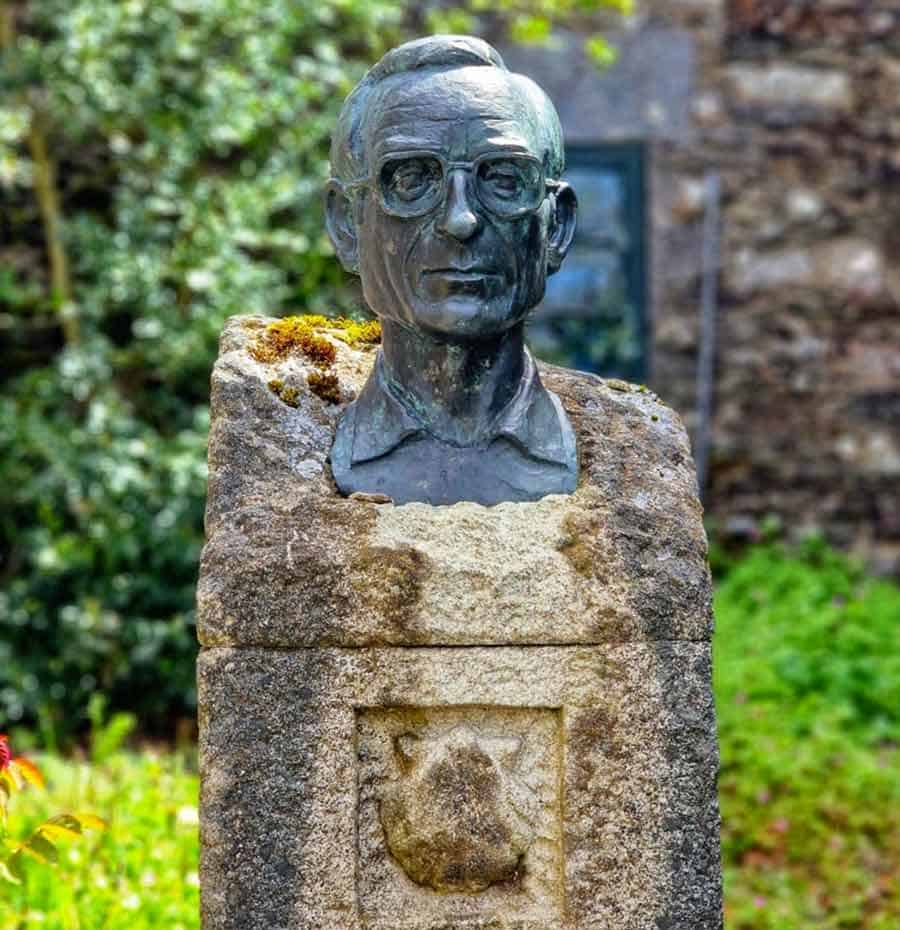
Camino arrows are one of the lasting legacies of Father Elías Valiña Sampedro, the parish priest from the tiny Galician village of O Cebreiro.
Born in Sarria, his doctorate focused on the pilgrimage to Santiago de Compostela, and in the late 1970s, he began planning the revival of the modern Camino. At that time, old pilgrimage routes had largely fallen into disuse, but Father Sampedro set off in his old Citroën van with a plan — and many cans of municipal yellow paint.
He cleaned up trails, researched historic paths, and began marking the route — with yellow arrows.
Why yellow? When Father Sampedro approached local councils for help, all they could offer him was municipal yellow paint. As it turns out, yellow shows up beautifully against stone, wood, and grass — and it stands out in both sunshine and rain. Best of all, they are easy to replicate by all the volunteers who would eventually join in the effort.
Over time, Father Sampedro enlisted the help of locals who shared his vision, and gradually the Friends of the Camino groups grew into an army of Camino-lovers who still manage, maintain, and repaint those arrows today.
He was only 60 when he died in 1989 and is buried in the church at O Cebreiro. And every pilgrim who follows a yellow arrow owes him more than a little thank you.
Types Of Trail Markers On The Camino De Santiago
I once walked with a lady who photographed every different marker she spotted… and by the end of here Camino she had quite a collection!
On the Via de la Plata, I also wrote a blog post about how the different Camino arrows and markers are a little like life — sometimes clear, sometimes obscure, some a little scruffy in places, or some new and fresh and bright. You’ll find them up high, low on the ground, sometimes beside us, sometimes underfoot, and occasionally, tucked around a corner when you don’t see them until the last minute.
But no matter how hard the trail, or where you are along the Camino, there will always be an arrow or a sign — showing you the way.

1. Yellow Arrows
Of all the markers you’ll see on the Camino, this is the most recognised. You’ll see them painted on trees, kerbstones, walls, bins, lampposts… even the occasional shed.
You’ll also see them incorporated into many other forms of Camino Marker. On tiles, on the stone distance marker and the brass plaques you see on the ground.
Over the years I feel I have an inbuilt radar to find them. It’s odd how I look up from my thoughts and there in front of me is an arrow… or maybe they’re so frequent that I didn’t see the ones I missed!
And if you’ve been walking for a few minutes and you’ve not seen an arrow or any kind of marker and it feels like you’ve missed a turn then stop and look around. Yellow arrows are so prominent that if you’ve take a wrong turn, not seeing them is an indicator that maybe you’ve missed something.
Top Tip : For occasions where I’m not 100% I’ll pull out the Wise Pilgrim app. It has a real time map and will show me where I am in relation to the trail. If I have wandered off, the app and the marvels of GPS will ensure I find my way back.

2. Scallop Shell
The scallop shell is another iconic and endearing marker of the Camino. Original, pilgrims carried a shell back from Santiago as proof of their pilgrimage but today we tend to wear them on our packs as a sign that we are indeed pilgrims.
The lines on the shell are said to represent the many paths that lead to the tomb of the Apostle – as all paths lead to Santiago.
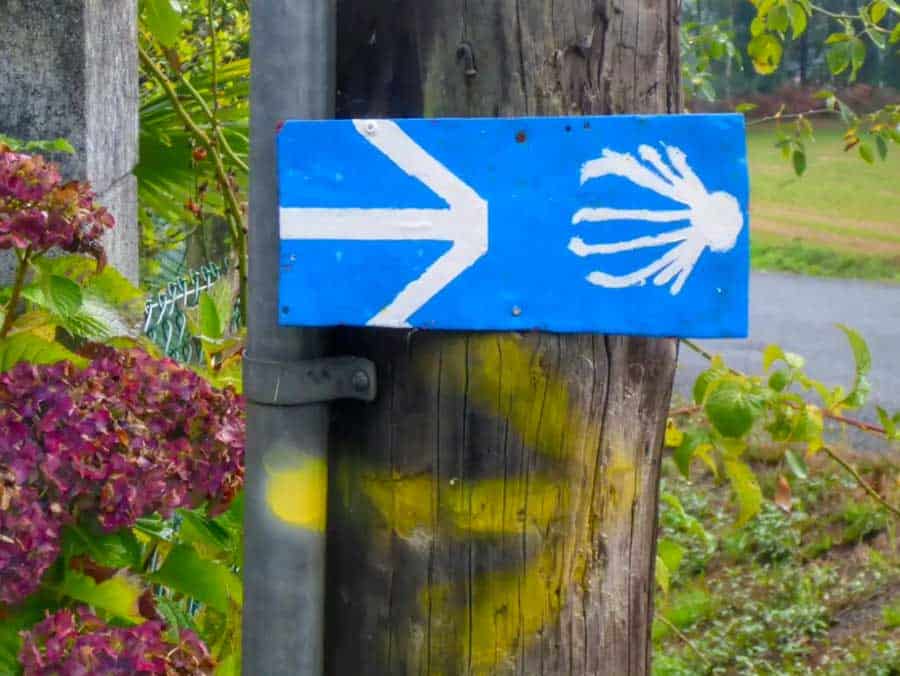
The oddest Scallop Shell sign I’ve ever seen was on the Sanabres Camino, leaving Ponte Ulla. A kind local had painted and created their own marker for pilgrims… but I couldn’t help thinking the shell was more akin to an octopus than the traditional scallop. But it made me smile and even now a decade later, I still remember it!
3. Stone Camino Distance Markers
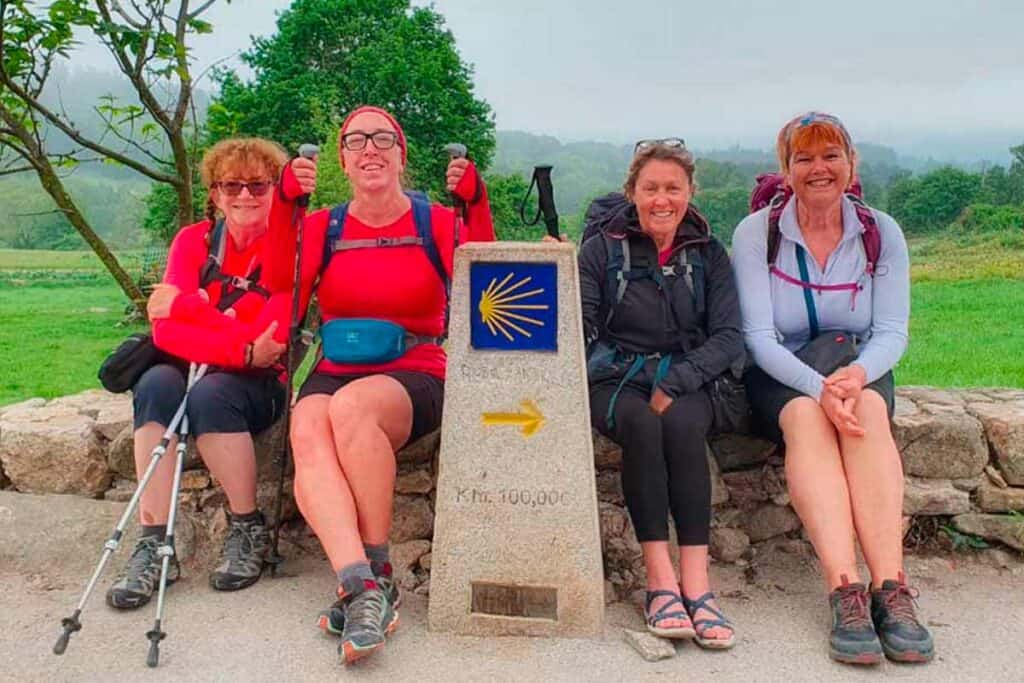
These solid grey concrete markers are a familiar sight along many Camino routes. They often feature a yellow arrow, a scallop shell, and the remaining distance to Santiago — though the design can vary slightly from region to region. Some are made of granite, others concrete, but they all share the same distinctive shape: trapezoidal, wider at the base and narrowing gently toward the top. They’re a modern nod to the Roman milestones that once marked ancient roads across Spain.
You’ll spot them most frequently on the popular routes like the Camino Frances, Portugués Camino, the Camino Inglés, the Primitivo, and the Norte — where they serve as regular reassurance that you’re still heading in the right direction. Many will incorporate a ceramic tile and the yellow shell or arrow (or both) along with the remaining distance to Santiago.
On some short variant paths, you might notice that the distance markers no longer show the kilometres but instead, they’re marked with the word “Complementario.”
This simply means you’re on a complementary or alternative route — often a scenic or historic detour — that will quickly rejoin the main Camino. Once back on the official trail, the distance markers will resume, like a little reward for returning.
As you get closer, they appear more often — and it’s a strange feeling, seeing your journey broken down into hundreds of metres. Some days, the numbers seem to crawl by and others they pass too quickly!
I’ve seen other styles of stone markers too — especially on the Via de la Plata. In Extremadura they looked more like chunky stone blocks and we used them as makeshift seats for a picnic more than once!
Top Tip: In recent years, some of these markers have been damaged — with tiles and distance plaques prised off and taken as souvenirs. Today newer markers are sometimes carved instead but if you see any vandalism on the trail, do call it out for what it is. Let’s keep the Camino marked for the pilgrims who come after us.

4. Bronze Floor Markers
Usually, in towns and cities along the Camino, you’ll often find small bronze or silver shells and arrows embedded in the pavement. They’re easy to miss — especially when you’re distracted by traffic, busy streets, or the sense that the end of your day is near — but they’re there if you look.
Each city seems to do it a little differently. Where I live in France, along the Voie de Vézelay in Perigueux, the Camino is marked with brass scallop shells set into the pavement, and I still get a little thrill when I spot them underfoot. In Pamplona, you’ll find silver discs and in Logroño, brass plates with yellow arrows point the way.
In Belorado on the Camino Francés, there are some wonderfully unique artistic plaques set into the floor, featuring handprints and footprints — and if you look closely, you’ll spot one from Martin Sheen, left during filming for The Way. And once on the Camino Aragones, we had yellow footprints leading us to the church in the centre of town.
Thankfully, these urban floor markers are often accompanied by the more familiar arrows and signs. I do find that finding your way in towns and cities is often the most difficult. It’s usually here where markers are more easily missed, and wrong turns are more common — especially when you’re hungry, distracted, or in search of coffee!

5. Cruceiros
While you might spot a cruceiro in other parts of Spain, it’s in Galicia that they truly belong. Some say there are over 15,000 of these stone crosses in the region, many standing at crossroads, village entrances, or along the Camino itself.
A cruceiro is a stone cross mounted on a pillar, often carved with figures of Christ, the Virgin Mary, or local saints. Though they’re sometimes mistaken for way markers, their original purpose went far beyond navigation.
They were:
Cruceiros are woven into the region’s deep folklore. One of Galicia’s most mysterious legends is that of the Santa Compaña, a ghostly procession of lost souls who wander the roads at night, carrying candles, shrouded in their own mist and led by a cursed living person. According to the tale, if you cross their path, you can find safety at a cruceiro — a place where these spirits have no power.
Thankfully, you’re unlikely to meet the Santa Compaña on your Camino — but the cruceiros still stand, keeping watch over the trail.
Though not official way markers, they’re usually found along the Camino, and their presence often offers a reassurance that you’re on the right path. And more often than not, you’ll spot a yellow arrow not far away.

6. Signposts
More and more frequently, you’ll spot signposts pointing the way at junctions and turnings along the trail. These vary from region to region, but most follow the traditional wooden or metal signpost style, often painted in blue or yellow to match the Camino’s visual identity.
They usually show the next destination and the distance — and while they’re generally reliable, I’ve been known to question a few over the years.
There’s one particular sign as you approach Estella that proudly announces just 4km to go — so convinced was I that it was wrong, I’ve even checked it against my GPS (more than once!). Sadly, I’ve had to accept that it’s probably my tired legs playing tricks on me as the sign is indeed correct!
Top Tip: When walking in autumn 2024, we noticed new signposts specifically for cyclists, marked with bike symbols and numbered routes — ours showed 1 and 3 inside a circle of stars. These markers are part of European cycling networks as well as the Camino, but they can be confusing, especially as they appear in the same places as pilgrim signs and sometimes look a bit like arrows.
If you see one, take a moment to check: is it for you or for cyclists? Most of the time, you’ll find a yellow arrow nearby pointing the correct way for walkers. And when in doubt, I always recommend checking your location using the Wise Pilgrim app, which shows you exactly where you are in real time.

7. GR Markings: Red & White Trail Signs
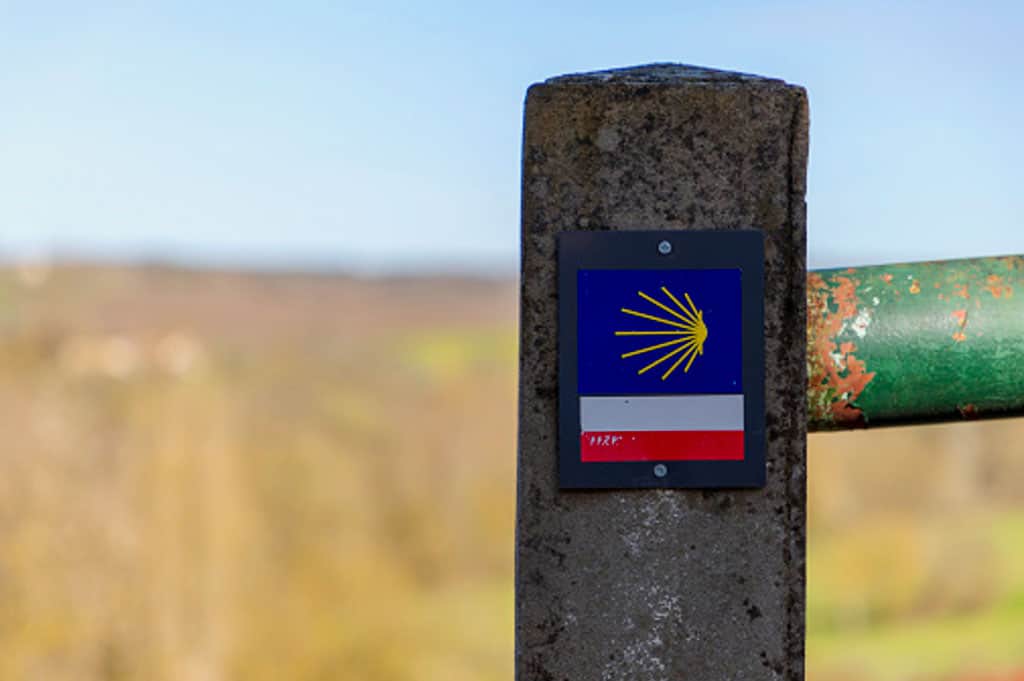
When walking at home in France, I’ll without doubt see GR trail markers — the red and white stripes painted on trees, posts, or walls, in much the same way as yellow arrows on the Camino. These belong to the European long-distance trail network, and GR stands for Grande Randonnée.
On the Camino, especially in France, you may well find yourself following a GR as well as the Camino, where they share trails. For example, the GR65 is better known to pilgrims as the Le Puy route but many French friends simply call it the GR65.
You’ll certainly spot GR markings when walking through the Pyrenees, but you’ll see them in Spain too where the Camino crosses other long-distance trails.
A red and white stripe means “this is the GR trail.” A red and white X means “not this way.”
Top Tip: Sometimes the Camino and a GR trail will cross paths with the Camino going in one direction and the GR another. If in doubt, always trust the yellow arrows or check your location on an app like Wise Pilgrim.
That said, I’ve never found these markers confusing while walking the Camino— they’re just another layer of waymarking to be aware of.
8. Red Cross of Santiago
The Cross of Santiago, with its sword-like ends, is instantly and always associated with Saint James.
You’ll see it on churches, atop poles, and painted onto Camino markers – also also on the top of many a Tarte de Santiago! There are many fine examples along the road from Astorga to Rabanal but you do also find them elsewhere

9. Cairns
Little piles of stones — often carefully balanced beside a trail or on top of a marker — are part of an ancient tradition that pilgrims today embrace. The Celts used cairns to mark high passes and hidden trails, and today they’ve become more about intention than direction — expressions of peace, prayers, or simply “I was here.”
Top Tip : Perhaps the most famous of all cairns along the Camino is the one that now holds in place the iron cross at Cruz de Ferro. Originally a Celtic cairn, adopted and used by the Romans and finally, a cross added to mark the way for pilgrims in medeival times.
That said, before you’re tempted to start a new one, it’s worth knowing that cairn-building has become a little controversial in recent years. There’s growing evidence that moving stones disturbs fragile ecosystems and causes erosion in certain areas. So instead of stacking, maybe just take a moment to pause and admire the landscape instead.

10. Other Signs Along the Way
Finally, there’s everything else — hand-painted tiles, stencils on walls, colourful murals, stickers, and even signs made by kind-hearted locals. Some are artistic, some are quirky, and many unique to the town or village you’re walking through.
Together, they form a visual language that pilgrims have come to understand —“Keep going. You’re on the right path.”

Finding The Arrows Through Towns and Cities
If there’s ever a place where pilgrims miss a marker or feel unsure about the way, it’s in the middle of a large town or city. Between traffic, shops, and tired legs, it’s very easy to get distracted.
To make things trickier, Camino markers will lead you into town and out again — but they won’t necessarily take you to your hotel, the nearest pharmacy, or the historic centre. If you’re looking for something off-route, the arrows may not be your friend.
When I arrive in a major city like Pamplona, I now have a system
A little planning goes a long way — I’ve had plenty of group members end up walking past the hotel turning and needing to backtrack, because they followed the arrows out of town. (Not sure if that’s a truth I should be sharing as a guide :D)
Also remember to note where you’ll rejoin the Camino the next morning. If in doubt, it’s worth checking the route before going to bed so you’re not fumbling in the early light.
Camino markers can be embedded in the pavement — brass or silver shells, small arrows, or even artistic plaques. You might also spot painted kerbstones, tiles on walls, arrows on lampposts, or even bins — but in the grey of early morning, they’re easy to miss. So do be extra vigilant.
Top Tips For Urban Camino Trails:
The good news? If you do miss a marker, you won’t stay lost for long — most cities are full of friendly locals and fellow pilgrims ready to direct you back to the Way.

When Camino Markers Are Missing Or Confusing
You’ve read this far, but there might still be a little voice saying, “Yes, but… what if I find the confusing arrow?” And I understand — it’s natural to worry, especially before your first Camino. So here are a few more common mix-ups and my tips to help put your mind at ease.
I can’t lie, it’s true that even with all the signs and symbols along the Camino, it’s still possible to go off trail — especially when you’re tired or distracted. Most confusion comes from markers that look official but aren’t. But also sometimes we’re chatting and we miss a sign, or we’re distracted by the view.
Here are some of the most common culprits:
When in doubt, look for the yellow arrow, but also take a moment to check your app or guidebook if you seek a little extra reassurance. You’ll rarely be more than a few metres from the right path — and if you’re unsure, ask a local or a passing pilgrim.
And sometimes, the confusion is almost comical… or maybe these things just tend to happen to me!
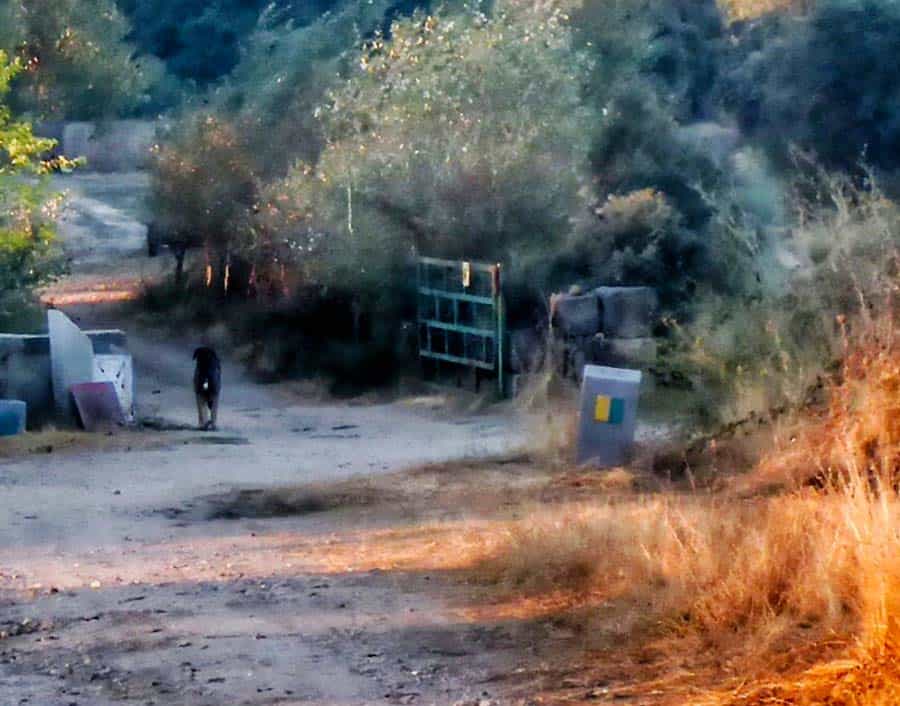
Once on the Via de la Plata, we passed a house with two very large dogs sitting outside. The trail ran right past them, we were in the middle of nowhere, and I’ll admit I was more than a little afraid. We tried to walk by quietly, but they sprang up, barking and running circles around us. We ran to the top of the hill in panic, only to look back and see the marker — right by the gate where the dogs were now sat.
We walked back sheepishly, the dogs now calm, sat watching us quietly. I’m pretty sure they raised their eyebrows as we wandered along. They weren’t chasing us at all — they were just showing us the right path! And a short while later we heard them furiously barking again and I suspect another pilgrim had missed that marker too!
And a final tip – not everyone with a rucksack is a pilgrim. We once missed a turning on the Primitivo by unknowingly following a local man… to his house! Thankfully, he never saw us and we quietly retraced our steps.
Camino Apps That Help You Stay on Track
It’s no secret that I love the Wise Pilgrim app — it’s my go-to Camino companion and always on my phone when walking. But I know there are a few other apps that pilgrims trust, so here are some options you might want to explore:
Want to learn more about the Camino? Then hop over to my Free Private Facebook Group | Walking The Camino De Santiago.
My Final Tips For Finding Your Way
Knowing how to find the trail was one of my biggest worries when I walked my first Camino. Friends and family imagined me wandering with a map and compass in hand, desperately trying to make it to the next village. But the truth is the Camino is very well marked.
I did have a bit of an advantage, as I was able to train on the Camino Vézelay which passes close to my front door; I’d already learned to spot the markers before I ever landed in St Jean. But for most folks, it’s a genuine concern.
Yes, there have been a couple of occasions where I’ve walked an extra kilometre because I missed a marker. And on some of the lesser-walked trails, we’ve had to stop and scratch our heads for a bit before working out the right direction. But that’s not the norm.
I’ve walked many thousands of Camino miles for more than a decade, and I could count those moments of real confusion on one hand. And even then — I found the trail again and all was well.
One of the true joys of walking the Camino, is that you can relax. You can trust the arrows. That sense of freedom — of knowing you don’t have to constantly check your phone or map — is one of the many things that makes the Camino so special. Someone has walked this trail before you and marked the path.
Of course, a good app is a helpful backup, and I’m a cheerleader for Wise Pilgrim and all the glorious uses I put my smartphone to… but when I’m walking? I follow the signs. The yellow arrows, the shells, and joyful mix of markers — all the way to Santiago.
And rest assured: you can too.

Are You Planning Your Own Camino?
If you’re starting to dream about your own Camino, I’ve written guides for each of the main routes — whether you’re drawn to the classic Camino Frances, the coastal charm of the Portuguese, or the wild hills of the Lebaniego, you’ll find practical posts and real-life advice to help you plan your way.
Or come and join our fabulous private Facebook group (it’s totally free!) or sign up below for our newsletter to get more Camino inspiration straight to your inbox.
Don’t Forget Travel Insurance
Whenever you travel, you should have great travel and medical insurance. None of us expect anything bad to happen, but in the event of an incident, you want to be sure that your insurance will cover you.
I’ve ended up in hospital in Peru, Indonesia, Portugal, Japan and Ireland. Every time my insurance took care of everything. I would never leave home without full and comprehensive insurance.
MondialCare : Due to increasing limitations, mainly due to age, we have recently switched to MondialCare for our travel insurance. We have taken an annual policy at a very reasonable cost that includes medical and other travel cover. There are no trip length limits and the upper age for cover is 84. For Camino walkers and travel in Europe they have a low cost Schengen policy with no age limit.
TrueTraveller : We have used this policy and were very happy with the cover, especially considering our ages and pre-existing conditions.
Globelink: We have used and recommended Globelink for years and not heard of any issues. They are a great choice for European and UK Residents.
Genki : This is an EU based company offering long term policies for nomads and travellers. Their monthly rates are very competitive for longer trips too.
Try Our Trip Planning Tools
Start here to find the best accommodation
Start here to find flights for your adventure
Start here to find the best sightseeing tours

Hey I’m Colleen. I’m married to Gerry, we’ve three fabulous kids and been living in France for almost two decades. I fell in love with Spain in the 1980s and I’ve walked 1000s of miles along the Camino de Santiago. Now we’re exploring and walking the world and I can’t wait to share what we’ve learned!