
Home > Spiritual Variant > Stage 1 – Pontevedra to Armenteira
Camino Portuguese Spiritual Variant: Stage 1 – Pontevedra to Armenteira
Some of my links may be affiliate links. If you make a purchase, I might earn a small commission at no cost to you. See our Privacy Policy for details. And this post was crafted with care and occasional typos by Colleen (and not AI)
If you’re walking the Camino Portuguese, you might also be considering the Spiritual Variant. This alternative path may add an extra day or two, but also plenty of history and legend along the way.
I’ve walked the Portuguese Camino many times, but it wasn’t until 2019 that we took the Variant, and we chose to extend it by a day, to stay in one of Spain’s most beautiful fishing villages.
When we walked, there was little information online, and while things have improved, many questions still remain; especially with regard to the distance required for your Compostela.

Feeling overwhelmed with planning your Camino?
Instead of searching endlessly, take a look at my Camino Planning Workshops. I turned over a decade of experience into a library of 20+ hours of practical, short, easy-to-follow videos, answering every question a pilgrim could have and plenty you’ve not thought to ask yet!
Stage One: Pontevedra to Armenteira
The route out of Pontevedra is straightforward, but as you divert from the main Camino, the path gradually rises; thankfully, a gentle incline for now. You’ll also notice a change in waymarkers: instead of the familiar yellow arrows, the Spiritual Variant is marked by a Saint James cross and a scallop shell.
The trail winds through small hamlets and villages before reaching Poio, home to its magnificent monastery. From there, you continue toward Combarro, a picturesque fishing village often ranked among Spain’s most beautiful.
There is a big climb up to Armenteira at the end of this stage, and many pilgrims opt to spend the night in Combarro. For this guide, I’ll follow the standard stages, but I’ll also include recommendations for shortening this stage if you have extra time.


Want to learn more about the Camino? Then hop over to my Free Private Facebook Group | Walking The Camino De Santiago.
Walking from Pontevedra
Before leaving Pontevedra, make sure to have breakfast; once you’re out of the city it’ll be a few kilometres before you find the next café. If your accommodation doesn’t provide breakfast, or if you’d prefer to skip the €22 Parador breakfast, there will be options in Pontevedra.
My favourite is Cafeteria De Ruas, tucked away in the old town at Praza da Verdura 14. It’s often busy with locals, and the square itself is wonderful at any time of day. Still it’s true what they say; the best café is the one that is open and serving coffee before you leave, and there will be many pilgrims and many cafés to choose from in Pontevedra.
And if you’re looking for accommodation in the town, these are a few of my favourites.

Finding the Arrows in Pontevedra
The arrows are easy to spot too as you leave, but only if your accommodation happens to be on the trail. If not, head back to the central (round) Igrexa da Virxe Peregrina, where you’ll find arrows that lead you out of town. And if in doubt, you’ll cross the wide pedestrian Ponte de Burgo over the Río Lérez to exit Pontevedra; and you’ll find arrows on the bridge.
In the suburbs it can feel like half the population is out walking, especially at the weekends. One Sunday I exchanged smiles with morning strollers, joggers and cyclists and a dad jogging whilst pushing his young son along on a tiny bike. So expect many greetings, and many Buen Caminos.
The path out of Pontevedra takes you from city to suburb and onto quieter country roads, walking between houses and stone walls. Always keep in mind that these are roads, not trails, and can be narrow in places with no pavement. Pay attention to vehicles coming from both directions.
The houses eventually give way to open countryside but you’ll continue along what feels like the same small road until you reach the point where the trail splits.

Pontecabras : The Spiritual Variant Split (3.4 km)
Just over 3km from Pontevedra, in Pontecabras, you’ll reach the junction where the Variant breaks from the main Camino Portuguese.
The Spiritual Variante is glorious but adds a few days to your schedule. Gerry and I have turned left here, heading to Combarro via the old monastery at Poio. By ignoring the yellow arrows and going left, you’re leaving behind the Via Romana XIX, or as Gerry called it, the R19.
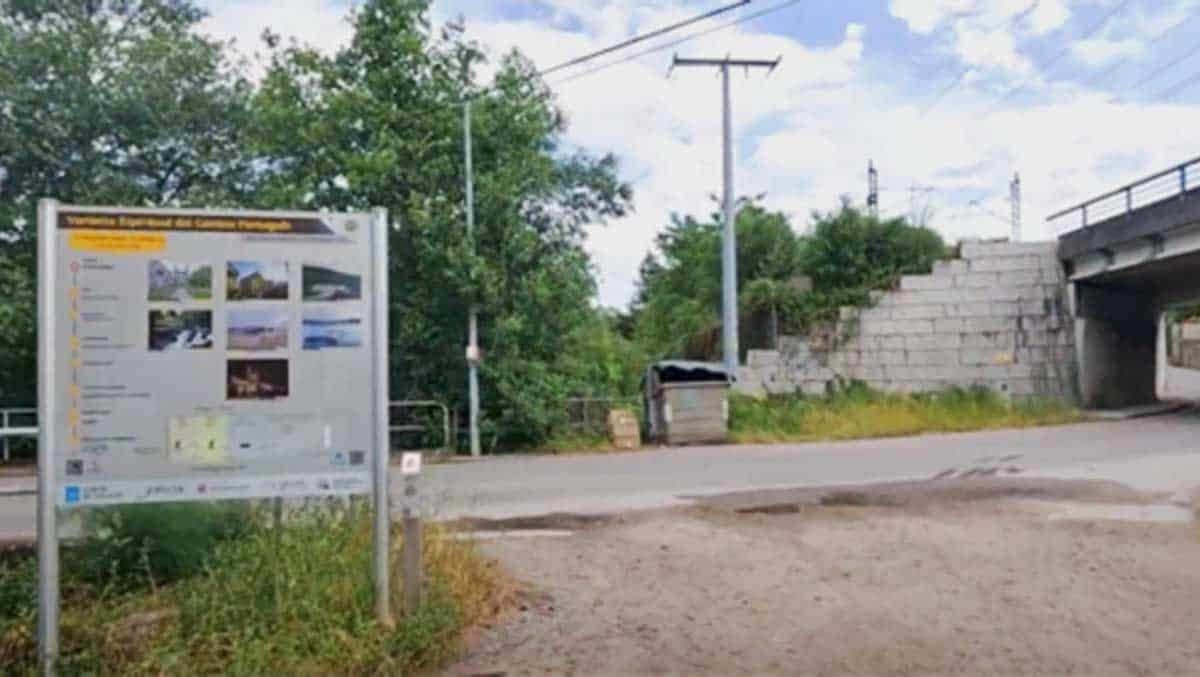
There is a helpful information sign on the left hand side, but it’s still easy to get swept away and just follow the crowds which means you’ll be turning right and heading towards Caldas de Rei.
The Camino Portuguese route slips under a rail bridge, so if you do that, retrace your steps and look for the sign (below) and the Variante marker, which is a wooden stake with a metal top with an arrow, a shell with the Saint James cross, there’s also a QR code for more info.
Further on there will also be grey signs that sometimes melt into the background, so keep your eyes peeled! There will also be painted yellow arrows to keep you on the right track.
Top Tip: These two paths do not meet again until Pontecesures, shortly before Padrón, so make sure you know which way you’re going. For the Spiritual Variant you go left.
If you miss the sign and the split, go back and retrace your steps as soon as you realise your mistake, as there are no shortcuts back to the Spiritual Variant.
From The Split In The Road
From the split the road starts to rise; consider this your warm-up exercise before the hill into Armenteira later. Within a few kilometres you’ll walk through O Freixo, passing it’s tiny Capilla de San Paio de O Freixo, onwards through Parada, where the trail ducks under the busy road, and towards Cabaleiro.
Keep your eyes out for the arrow pointing steeply up into the woods, and follow the short trail up to a small clearing with a few vines before carrying on up through the woods.

Cabaleiro (2.4 km)
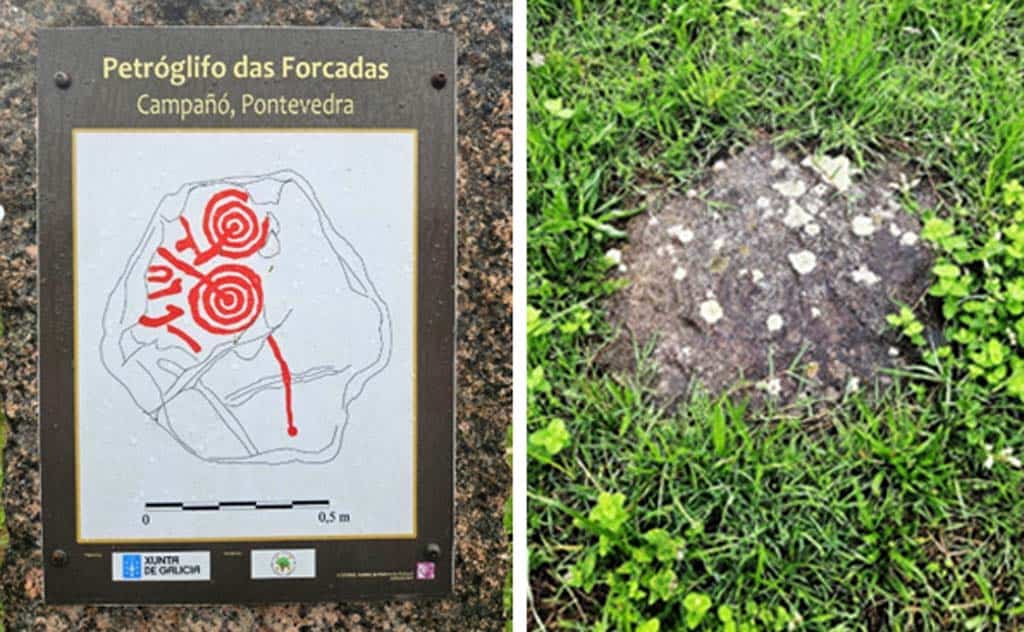
You’ll enter the village near the Igrexa de San Pedro de Campañó, originally built in the medieval ages and reconstructed in the 18th century. Sadly it tends to be locked. A café (and toilets), is only a short distance away, and on the way there you pass a small park area and a rather intriguing sign.
Petróglifos, or petroglyphs, are ancient stone carvings, and this area has quite a few. Though not very big, it used to be part of a bigger complex nearby, carved in the early Bronze age approximately 4,000 years ago. Can you see the pattern?
If you need a break after the hill, you can pause on the wall beside the church, stop for a coffee and a stamp at Hotel Campaniola, or keep walking for a few minutes further to Café-Bar Restaurante La Viuda. When we stopped here, there was a wedding in full swing, but thankfully they still served us lunch.
Continue through Cabaleiro, following the markers out of town, and soon you’ll be back onto wooded trails, weaving in and out of quiet country roads, before descending again toward the sea and the Monastery of Poio.

Monasterio de Poio (3.3 km)
The Monasterio de San Xoán de Poio is absolutely worth a visit, but you’ll need to time it well, as it closes in the afternoons.
The monastery dates back to at least the 10th century, although legend suggests it was originally founded by San Fructuoso in the 7th century. According to tradition, he miraculously walked across the waters to the islet of Tambo to rescue a sinking boat.
You’ll also find the tomb of Santa Trahamunda, a nun abducted during a Moorish raid and imprisoned in Cordoba for eleven years. Her unwavering faith led to her miraculous return to Poio, where she spent the rest of her life.
During the Middle Ages, the monastery flourished under the Benedictine Order. The monks left in 1835, but in 1890, the Order of La Merced took over and continues to maintain it today.
As well as the immense history of the building visitors can also explore :

Visiting the Monastery At Poio
Visitors are welcome to explore parts of the monastery, including the cloister and church. Guided tours are available, although often in Spanish and it’s advisable to check visiting hours and tour availability before you arrive.
Visiting Hours:
Staying at the Monastery
You can also spend the night at Hospedería Monasterio de Poio and it would be a great option for breaking the stage. Having stayed in many convents and monasteries over the years, I can say that it’s a wonderful experience.
Rooms are simple but comfortable, each with a desk, reading light, and private bathroom. The environment offers pilgrims a unique opportunity to experience monastic life whilst walking the Spiritual Variant.

Combarro (2.8 km)
Leaving the monastery, the trail winds through quiet residential areas, following a well-marked path as it eventually drops down to Seca on the coast. Here, you’ll pass the Campo de Fútbol da Seca and enter Parque da Memoria (often called Parque de A Seca).
From this point, the trail runs beside the water, it’s a glorious little path that reminds me very much of the little coastal walk around Arcade, looking back toward Redondela. The park is a wonderful space, with benches, shady trees, and fabulous views over the Ría de Pontevedra; perfect for a picnic!
The highlight of Parque da Memoria is its central green area and the sculptures designed by artist Pérez Esquivel. This Argentine artist is the son of an emigrant from Combarro and winner of the Nobel Peace Prize in 1980.
His gift to Poio was the design of a series of sculptures mounted on a large compass rose and surrounding a central seed-shaped sculpture. They are a series of six granite monoliths representing the phenomenon of emigration from the five continents, the cult of memory, and peace. The entire complex was inaugurated in 2009, almost a decade after the Nobel Prize winner’s first visit to Combarro.
All too soon though the little trail leaves the park, and the Camino markers return you to the road as you approach Combarro.
When we first walked this path, we’d been following a donkey for days. We never saw him, but every day, we’d find fresh donkey poop along the way. Gerry nicknamed him Shinto, after the donkey in Tom Moore’s book about walking the Camino Frances with a donkey.
We were sad when we left the Camino Portuguese as we thought we’d never catch him but when we reached Parque de A Seca and found fresh donkey poop, we were thrilled! Yeah, we still had a chance to catch up with Shinto!
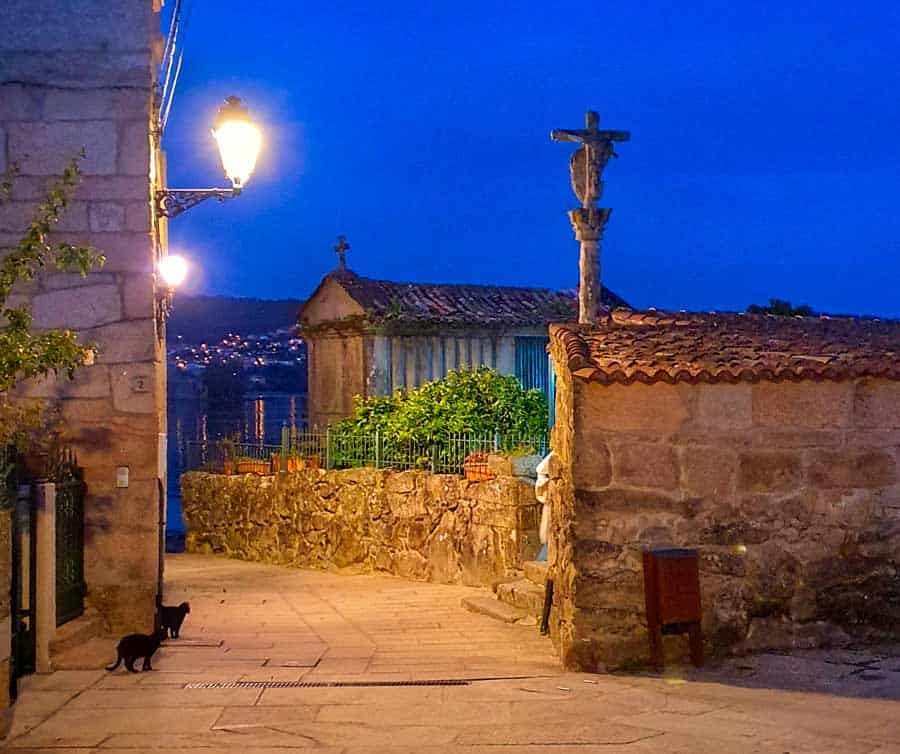
The way-markers skirt the village, but whatever you do, do not leave without exploring. Combarro is considered one of the best preserved villages in Galicia. Famous for its photogenic waterfront lined with horreos, used to dry fish, and the old town with narrow, winding streets, it is certainly one of the most charming.
If you have time, I highly recommend breaking your journey here; wander the beaches, explore the stone houses and narrow streets, and enjoy fresh seafood from the bay at one of the waterfront restaurants. If you’re lucky, the tide will be in at dinner and you’ll hear the waves gently rolling in as you eat. It truly is a wonderful place to spend the night!
Where to Stay In Combarro

Mirador de Loureiro (3.4 km)
If you stayed in the old town of Combarro, find the arrows to rejoin the trail. From Hotel Combarro, we had to walk toward the old town to find them. Either way it’s well marked. No matter where you stayed, the route quickly turns inland and begins the climb and this one will definitely test your legs!
Top Tip: There is a Froiz supermarket on the main road where you can get water, food, and snacks before leaving Combarro, as there will be no more shops or cafés before Armenteira.
Over the next 7 km, you’ll walk up over 400 meters. Thankfully, it’s not all steep and there are gentler stretches where you can catch your breath.
The walk begins in the town, but you’ll soon find yourself climbing through narrow residential lanes. Do pay attention to the signs as the trail twists back and forth.
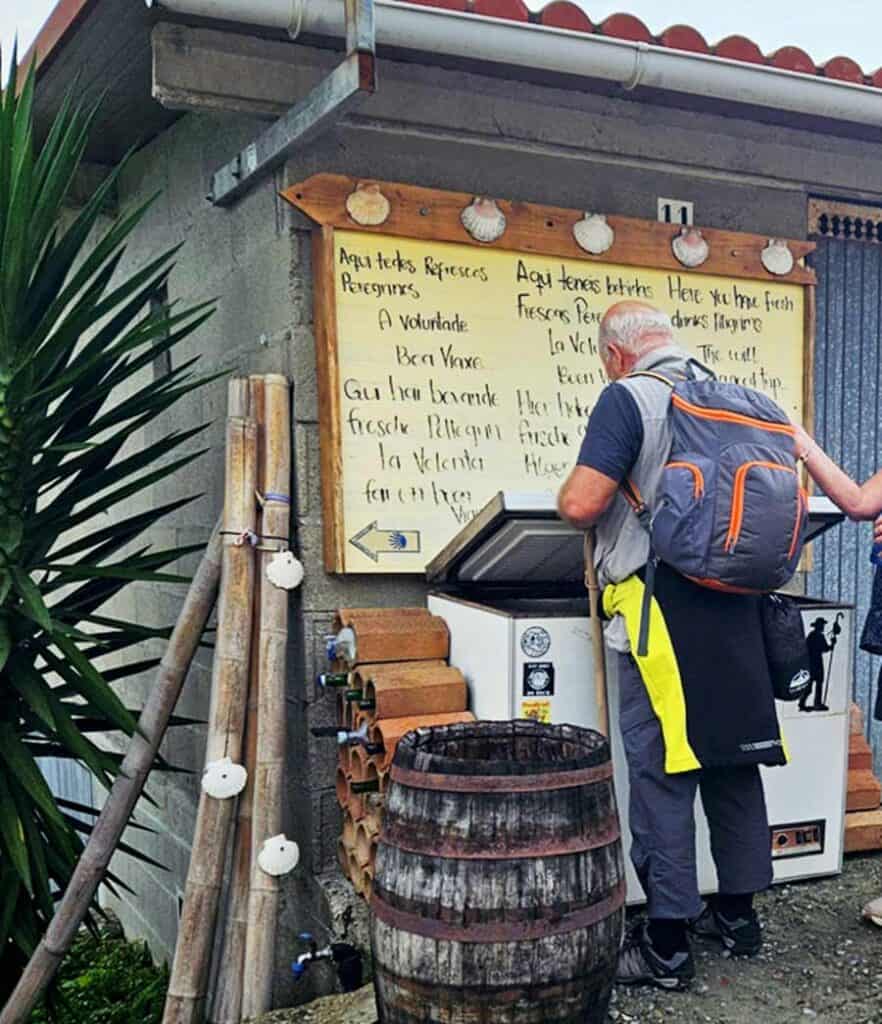
Top Tip: At the very top of the residential area, there is a large cooler with water and soda bottles, unmanned and donativo, meaning you leave your euro or so in the bowl for whoever keeps the cooler stocked for hot pilgrims.
The higher you go, the more rural it becomes. Most of the ascent follows quiet roads and forestry tracks. The first place to sit down to rest is the Mirador de Loureiro, where a platform with seats offers fabulous views of the water now far below.
Back on forest trails, you’ll keep climbing gently for another 1.3 km before reaching a second viewpoint, Miradoiro de Cal Marroco. From here, you’re close to the top, just a little more up and then downhill all the way!
Along this section, you’ll pass yet another prehistoric rock carving.


Petroglifos de Outeiro do Cribo (3.3 km)
The Petroglifos Outeiro do Cribo are one of the more significant Bronze Age petroglyph sites in Galicia. The carvings are more than 4,000 years old and include labyrinths, concentric circles, and animal figures that look like deer.
The Camino passes close by the site, but the sign seems to have gone missing; fingers crossed it might be replaced soon! As you come to the top of the hill, the camino crosses the CF-102 road and you can either follow the road up a bit and then turn left, or go straight across and take a 350-meter forest trail to a gravel road.
The large carved stone lies 20 m up from the road on the right hand side as you continue; if you’re lucky the grass and underbrush will be cleared to make it easier to spot. It doesn’t look like much at first sight, but look for the circular labyrinth and you might see the deer below!
From here, the path begins to drop, mostly through forest trails, and keeps going down all the way to Armenteira.
As you get closer, the trail turns sharply to the left from the forest road and winds down towards the monastery through the woods. Some parts are rocky and require you to take your time and watch your step; if it is or has recently been raining you can still follow the road you are on and then turn left further down. It might be safer but it’s still steep! Hiking poles will definitely help today!

Monasterio de Armenteira (2.2 km)
The Monasterio de Armenteira was founded in 1167 and completed in the late 12th or early 13th century. After falling into decline in the 19th century, the monastery was revitalised in 1989 by a group of Cistercian nuns from Navarra. Who continue to maintain the monastic traditions of offering a place of peace, prayer, and reflection.
The Sisters here are wonderful. We’ve stayed in many monastic accommodations over the years, and I have to say that the kindness and welcome I received here was very special.
The Legend of Don Ero and the Little Bird
There is a legend linked to Monasterio de Armenteira. Don Ero de Armenteira, a noble knight, founded the monastery in the 12th century. One day, he prayed to the Virgin Mary, asking for a glimpse of heavenly paradise.
As he wandered the forest, he paused to rest and listened to the song of a small bird. Enchanted, he lost all sense of time and when he returned to the monastery, he discovered that 300 years had passed! His fellow monks were long gone and his story became one of Galicia’s most famous miracles.
Accommodation at the Monastery
If you wish to stay, you must keep in mind that the purpose of staying should be for reflection and prayer. The monastery carefully maintains a quiet, meditative atmosphere.
Even if you don’t stay overnight, I recommend visiting the monastery and supporting the Sisters by purchasing something from their small gift shop, selling soaps, skin creams and even scents made on the premises. Their shell shaped soaps make for practical and pretty souvenirs.

Armenteira
Armenteira is more than just the monastery, it is a little oasis for weary folk outside the monastery walls too. This little village has served nuns, pilgrims and travellers for centuries and offers food, lodgings and rest. Now near a rural road, it is easier to access for non-walkers and offers accommodation for every price range.
Where to Eat in Armenteira
There are two bars right outside the monastery, Café Bar A Fonte and Bar O Comercio, serving the pilgrims passing by or staying the night.
Both of them tend to be busy with tired, hungry and thirsty guests, but if you can find a shady table outside, it’s the perfect place to rest after the long climb.
When we arrived, a group of young men on horseback had gathered and broke into singing and dancing, giving us an impromptu show of traditional horse dressage. It’s a great way to end the day!
Where to Stay In Armenteira
Choosing where to stay in Armenteira can be tricky. Accommodation is limited, and with the Variante growing in popularity, booking ahead is a good idea; especially if you wish to stay in the albergue.
There are three main options:
Alternatively, if you stayed in Combarro and feel strong after the climb, you could walk on; the next accommodation is around 6.5 kms away. Alternatively, there are a few rental houses slightly off the Camino, which could be worth considering if you’re a group.
Feeling overwhelmed with planning your Camino?
Instead of searching endlessly, take a look at my Camino Planning Workshops. I turned over a decade of experience into a library of 20+ hours of practical, short, easy-to-follow videos, answering every question a pilgrim could have and plenty you’ve not thought to ask yet!

Potential challenges on this stage
This is a varied stage, ending with a long climb with no services, but it has a bit of everything – natural beauty, history, charm and challenge – so take your time and enjoy all it has to offer.

Recommended Apps, Books And Websites for the Spritual Variant
If you’re walking any stage of the Camino Portuguese, these apps, guidebooks, and websites are invaluable. Be sure to download or purchase them before leaving home:
Final Thoughts: Spiritual Variant From Pontevedra to Armenteira
When we first walked this route, I wasn’t sure what to expect. I knew that the walk from Pontevedra to Caldas de Reis, and onwards to Padron, was beautiful; I was curious how this route could improve on that. And yet it did.
The Monastery at Poio is impressive, but the Sisters of Armenteira stole my heart. Combarro is glorious, and our evening dinner by the sea was joyous. And if you wait for the sun to rise, the walk along the Ruta da Pedra e da Auga is mother nature at her finest.
Walking the stage from Pontevedra to Armenteira in one go is quite a lot and more than that, it doesn’t give you time to explore any of the treasures along the way. Break this stage; stay in Combarro. Explore Poio and the coastal path and allow yourself time in Armenteira.
Today is a beautiful stage and one to be savoured; I can’t wait to walk it again!
Want to learn more about the Camino? Then hop over to my Free Private Facebook Group | Walking The Camino De Santiago.

Are You Walking The Portuguese Camino?
I’ve walked the Camino Portuguese many times, in all its forms, and I know that I’ll walk it again. If you’re walking from Porto to Santiago, I’ve created detailed daily guides packed with route tips, accommodation recommendations, and insights to help you along the way.
Here are some posts to help you plan your journey:
If you’re planning your Camino or are already on the trail, I’d love to hear about your experiences! Join my private Camino community on Facebook, share your stories, find inspiration and connect with fellow pilgrims.
Don’t Forget Travel Insurance
Whenever you travel, you should have great travel and medical insurance. None of us expect anything bad to happen, but in the event of an incident, you want to be sure that your insurance will cover you.
I’ve ended up in hospital in Peru, Indonesia, Portugal, Japan and Ireland. Every time my insurance took care of everything. I would never leave home without full and comprehensive insurance.
MondialCare : Due to increasing limitations, mainly due to age, we have recently switched to MondialCare for our travel insurance. We have taken an annual policy at a very reasonable cost that includes medical and other travel cover. There are no trip length limits and the upper age for cover is 84. For Camino walkers and travel in Europe they have a low cost Schengen policy with no age limit.
TrueTraveller : We have used this policy and were very happy with the cover, especially considering our ages and pre-existing conditions.
Globelink: We have used and recommended Globelink for years and not heard of any issues. They are a great choice for European and UK Residents.
Genki : This is an EU based company offering long term policies for nomads and travellers. Their monthly rates are very competitive for longer trips too.
Try Our Trip Planning Tools
Start here to find the best accommodation
Start here to find flights for your adventure
Start here to find the best sightseeing tours

Hey I’m Colleen. I’m married to Gerry, we’ve three fabulous kids and been living in France for almost two decades. I fell in love with Spain in the 1980s and I’ve walked 1000s of miles along the Camino de Santiago. Now we’re exploring and walking the world and I can’t wait to share what we’ve learned!