
Home > Spiritual Variant > Stage 2 – Armenteira to Vilanova de Arousa
Camino Portuguese Spiritual Variant: Stage 2 – Armenteira to Vilanova de Arousa
Some of my links may be affiliate links. If you make a purchase, I might earn a small commission at no cost to you. See our Privacy Policy for details. And this post was crafted with care and occasional typos by Colleen (and not AI)
Stage two of the Spiritual Variant is all about the river trail. When I first learned of this alternative along the Camino Portuguese, it was the Ruta da Pedra e da Auga (the Route of Stone and Water) that interested me most.
The more I read, the more I wanted to walk it for myself. So, one sunny October morning, we left Pontevedra, took the trail to Combarro and onwards to Armenteira. From there, we followed the Ruta da Pedra e da Auga, letting the river and the arrows lead us all the way to the beautiful seaside town of Vilanova de Arousa.
This stage of the Spiritual Variant is a longer day, but there are lovely places to pause along the way. And if, like us, you’d rather savour it slowly, there are options to shorten the day; not a bad idea if you plan to linger along this most beautiful path.

Stage Two: Armenteira to Vilanova de Arousa
If you’re walking from the Monastery at Armenteira, today is a longer stage, and the first few kilometres along the river are naturally slower. There are rocks and tree roots and a few muddy sections.
That said, this is a glorious little corner of Galicia which deserves to be fully explored, so make sure you book your bed in Vilanova de Arousa, and take your time.
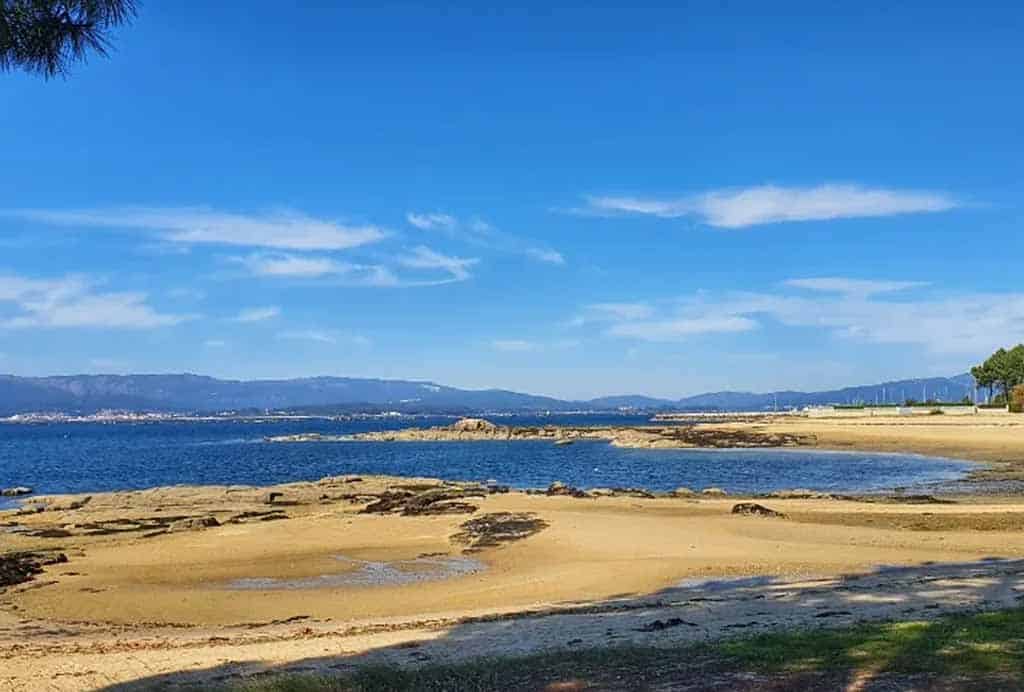
The trail is well marked, weaving through forests and criss-crossing the river throughout the first half of the day. The final few kilometres take you back to the coast, along sandy trails near the beach.
Top Tip: Services are sparse today, especially at the start. The first time we walked it was October and most of the seaside bars were closed; be prepared to carry plenty of water and snacks.


Feeling overwhelmed with planning your Camino?
Instead of searching endlessly, take a look at my Camino Planning Workshops. I turned over a decade of experience into a library of 20+ hours of practical, short, easy-to-follow videos, answering every question a pilgrim could have and plenty you’ve not thought to ask yet!
The Ruta de Pedra e da Auga
Today’s walk almost begins at the entrance to one of Galicia’s most stunning trails; the Ruta da Pedra e da Auga (Route of Stone and Water), which follows the Armenteira River.
The trail winds through natural woodland, with sections that can be rocky and interlaced with tree roots. As you progress, the path widens and flattens, making for an easier walk.
Top Tip : Some areas can be slippery, especially after rain or a heavy morning dew. Thankfully the trail is so glorious that it almost rewards the unhurried approach; so enjoy the walk and take your time.
Initially, the river will be on your left. As the day unfolds, you’ll cross to the south side, where the river will be on your right, offering gorgeous views of the Rías Baixas vineyards, famous for Albariño white wines. But first the woodland!
Do have breakfast in Armenteira before starting today because :
The morning light transforms the forest and brings it to life. Linger a little over breakfast so that you don’t miss Mother Nature’s light show.

The Watermills
The Ruta da Pedra e da Auga is home to over 30 historic watermills, many of which have been restored. Some date back several centuries, built to harness the river’s flow to grind grain into flour. Each mill is identified by name, with information boards explaining how they worked.
This ancient path was originally used to access the mills but was also a pilgrim route. On Easter Monday, pilgrims walked this trail to reach the Santa María da Armenteira Convent.
The mills fell into disuse as modernization and industrialization spread across Spain and by the mid-20th century, most had been abandoned. However, in the late 20th century, the trail and its mills were preserved, recognized for their cultural and historical value as part of Galicia’s heritage.
This really is a beautiful trail so allow time in your planning to meander. It’s for this reason I suggest breaking the stage, to allow you plenty of time and not feel rushed. Explore the mills, read the history, and wait for the sun! It really does make all the difference.

Aldea Labrega (3.9 km)
The Aldea Labrega, also known as Aldea de Pedra (Stone Village), is a small collection of statues (people, animals and buildings) representing the typical Galician village.
There’s not a great deal to see but it’s still worth the short detour; especially as the trail leads to the small café Gastrobar Ruta da Pedra e da Auga (open from April to October). Here you’ll find homemade cakes and breads, some of them gluten free! And offers delicious coffee and clean bathrooms.
This could be the perfect place to stop awhile and enjoy the memory of one of the most beautiful parts of this Camino.
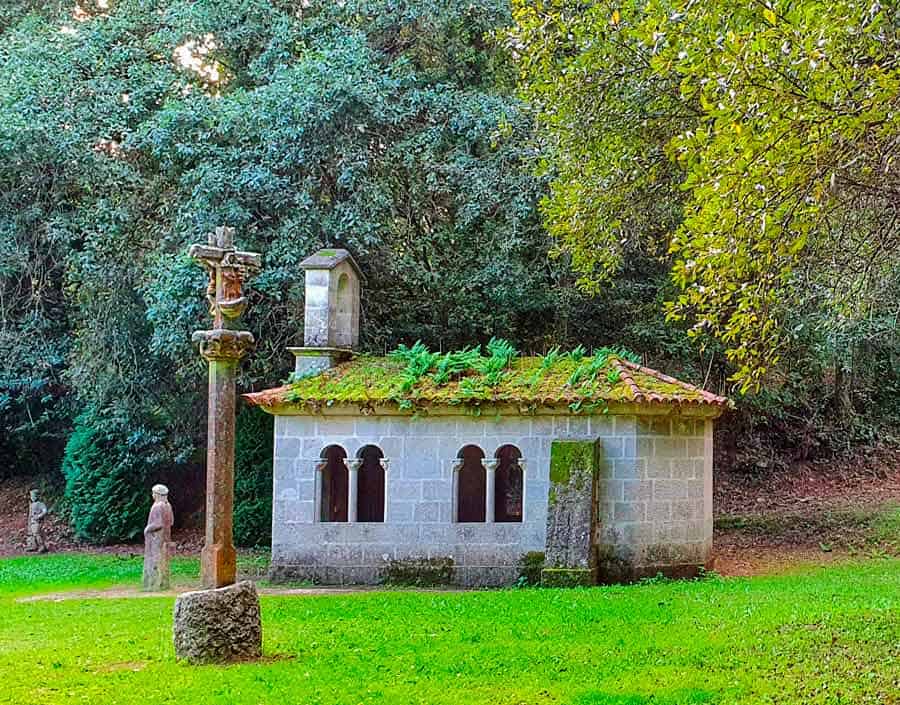
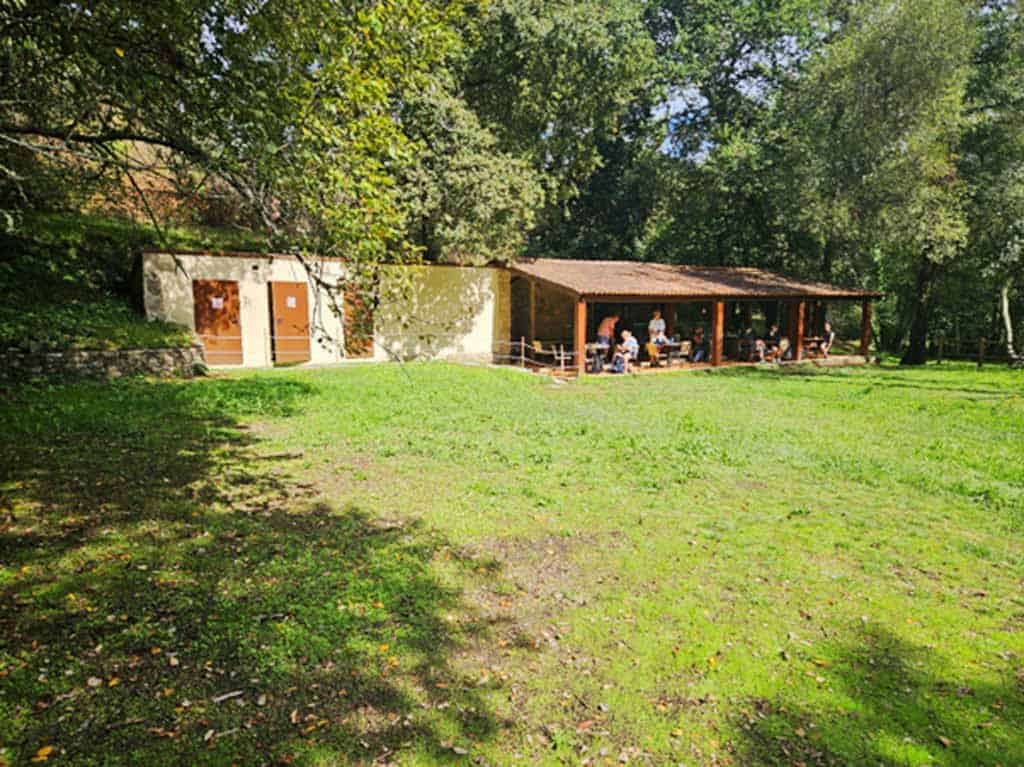
From here, you leave the natural forest and the trail opens up a little. You’ll cross a few roads before crossing to the other side of the river. This section is known as the Route of the Mills of Barrantes, and you’ll pass more restored watermills, each a little different than then others.
I can’t tell you how much Gerry loved these mills. He had to stop at every one! It took us forever to walk this section, but it was worth it.
Want to learn more about the Camino? Then hop over to my Free Private Facebook Group | Walking The Camino De Santiago.
Castaños / Barrantes (2.8 km)
You’ll find services here, making it a good spot for a break. If you’re considering splitting this stage, or walking on from Armenteira, there’s a small hotel about 6.5 km from the monastery which could be perfect.
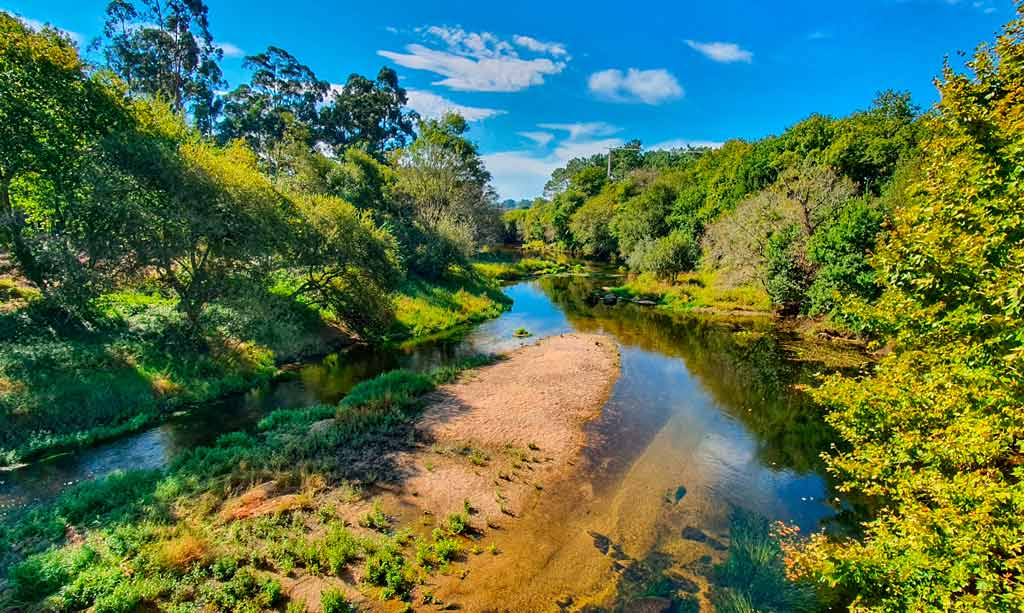
Birdwatching Along the Way
Leaving Castaños, the trail returns to the river, this time the Umia River, crossing bridges as you’re walking both sides of the water. You’ll notice more and more vineyards and farmlands but we also noticed a lot of birdlife. After a little research we found that the habitats here support a rich array of birdlife including:

Ponte Arnelas (5.9 km)
Leaving the river trail you arrive in Ponte Arnelas. There are services here and a lovely little Casa Rural, making it an ideal place to break the stage.
Ponte Arnelas sits along the Umia River, marking the boundary between Ribadumia and Vilanova de Arousa. It is best known for its historic stone bridge, locally called Ponte dos Padriños (Bridge of the Godfathers) and is home to a rather unusual tradition.
The Legend Of Ponte dos Padrinos
While the current bridge was built in the 16th century, it stands on Roman foundations. But Ponte dos Padriños is also steeped in local folklore. According to tradition, women who had difficulty carrying pregnancies to term would take part in a fertility ritual here.
Ponte Arnelas is a wonderful place to break this stage; but if you’re walking back to your accommodation after dark, keep an eye out for any mysterious midnight processions…

San Roque do Monte (7.8 km)
Leaving Ponte Arnelas, you’ll pass the ancient Capilla de Santa Marta. Its origins are uncertain, but its proximity to the bridge suggests it has been a site of pilgrimage for centuries.
The trail leads you through Gombra, Mouzos, A Igrexa (Tremoedo), and A Igrexa (Deiro) for around 3.5 kilometres. At A Igrexa, you’ll leave the road and follow a forest trail for a short while, facing the only real elevation of the day. Thankfully it’s a gentle climb and nothing like the hill to Armenteira.
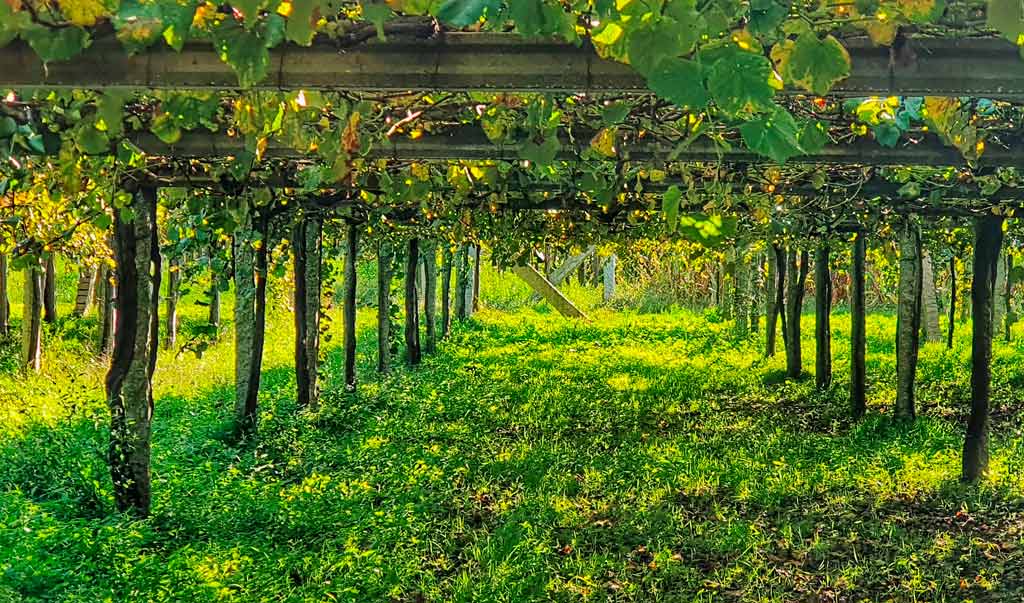
From the top, you’ll return to small roads, walking past vineyards, lots of vineyards as you’re walking through the Rías Baixas wine country.
Why Two A Igrexa on the map?
Since both Tremoedo and Deiro are small parishes, their churches serve as landmarks, which is why the name A Igrexa (The Church) is used.
Top Tip: Check if the churches are open as you might find a Sello for your Credential.
You’ll reach San Roque do Monte, a small village, famous for its annual Festival, held on the first weekend of September. If you’re walking at the right time, you might find yourself in the middle of a donkey race! And if not, you can still stop for a quick photo with the stone donkey near the church.

O Terrón (2 km)
Just 1 km from San Roque do Monte, the trail rejoins the coast and shortly after this you reach what feels like a little resort. The coastline around O Terrón is lined with campsites and cafés.
It’s a simple beach, no kiss-me-quick hats and many cafés close in the off-season. But we found a shady seat and enjoyed ice-cold cokes and an ice cream before walking the final few kilometres into Vilanova de Arousa.
If you’d rather spend the night here beside the beach there are a few options, many are campsites but you can book a room at Hostal Luz de Luna; where we stopped for our cold drinks.

Vilanova de Arousa (2 km)
While the name Vilanova suggests a new town, the settlement as we know it was probably established in medieval times. Historically, Vilanova de Arousa was connected to the sea and its economy long relied on fishing and seafood, particularly mussel farming.
Today, it is one of Galicia’s primary mussel-producing areas, holding its own protected designation of origin (PDO): Mexillón de Galicia. With a mollusc allergy, these are an absolute no-no for me but I can assure you that Gerry has been happily eating his way through the seafood along this coast!
If you are lucky enough to visit in the second week of August, you might even get to experience the annual Festa do Mexillón e o Berberecho – the Mussel and Cockle festival, offering a full program of music, a food tent, a maritime procession and other activities.
For pilgrims, Vilanova is the gateway to the Traslatio Route, the maritime path linked to the legend of the Apostle James’s body being transported to Galicia. And of course, it is for this reason that we walk here.

Where to Stay in Vilanova de Arousa
There are several accommodation options in town, including a municipal, two private albergue, apartments, and hotels. If you’re walking outside of peak season, do be aware that some restaurants, shops, and accommodations may be closed, so it’s best to check ahead.

What to see and do in Vilanova de Arousa
Galician playwright, novelist and poet Ramón del Valle-Inclán was born in Vilanova, and you will see statues and pictures of him in this area, easily recognisable with his round glasses and long hair and beard.
You can visit the Casa del Cuadrante, his birthplace, which was declared a National Historic Monument in 1976 and now houses administrative offices, a reception area, and an exhibition hall and garden. There is also a statue of him in the Alameda park in Santiago de Compostela.
Or if you’re not up to much when you arrive, why not just stroll along the waterfront, enjoy some fresh seafood and look forward to the boat journey!
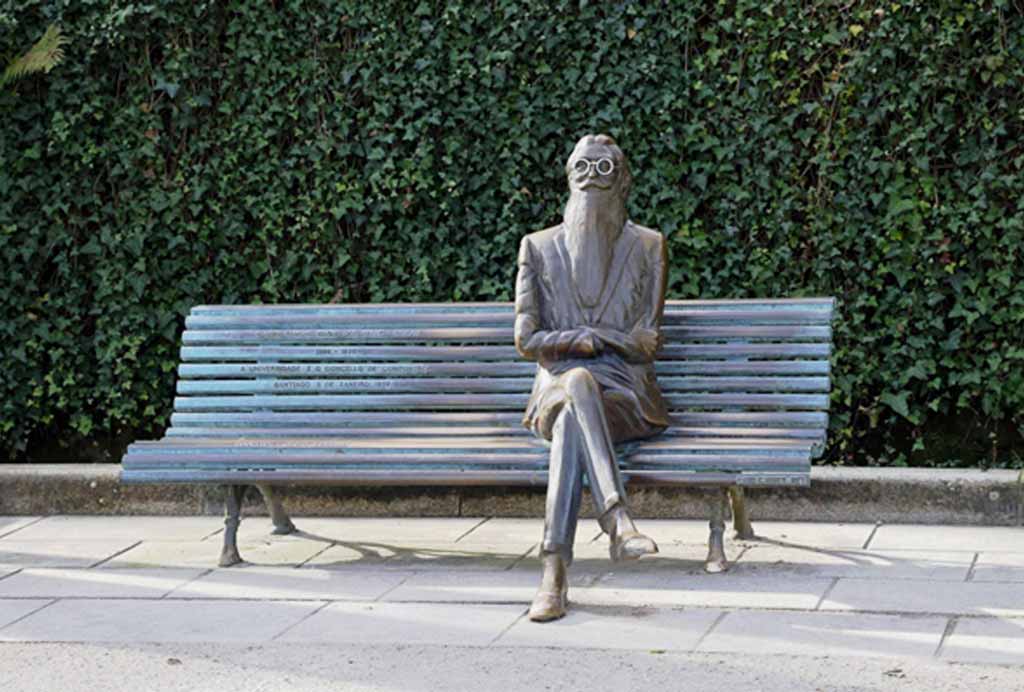
Visiting Torre de Cálago
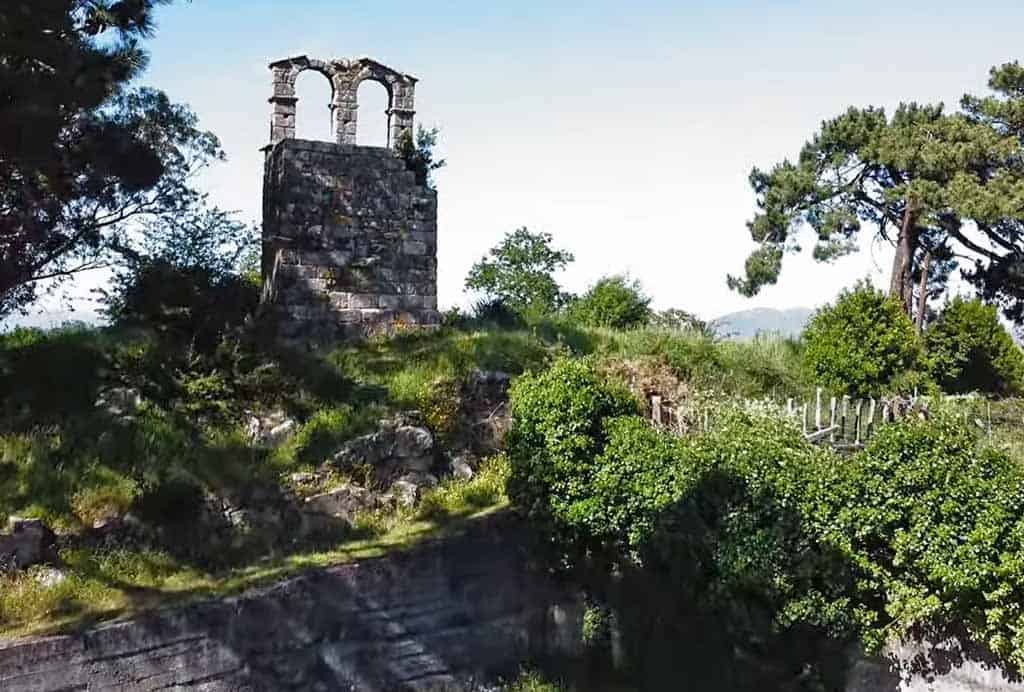
If you have time and you like to explore, you might wish to visit the Tower of Cálago, the only remaining vestige of the ancient Monastery of San Cipriano de Cálogo.
A lone tower is all that remains of the ancient Benedictine monastery of San Cipriano de Cálago, founded by Saint Fructuosus in the 7th century, destroyed by Norman attacks in the 9th and 10th centuries.
Set a little distance from the monastery itself, it is thought to have had a defensive function, and would have warned nearby villages of any potential invaders arriving from the sea by ringing its bells.
The Cálago tower sits on Rúa Campo, a short five minute walk from the town centre, on the highest point of the adjacent land. The square base is built of granite blocks, and at the top is a part of a bell gable with two arches where two bells would have been. You can also see the external staircase winding up to the bell tower.
A document dated 884 records a donation to the monastery and makes express mention of the pilgrims to Santiago de Compostela, making it the oldest known reference to the Camino de Santiago in the region.
The Cipriano name is carried on in the much more recent Iglesia de San Cibrán, and across the street from it is the ruins of the 15th Century San Mauro chapel, with a few remains of the old Calágo monastery church inside; all testament to Vilanova de Arousa’s religious history.
Feeling overwhelmed with planning your Camino?
Instead of searching endlessly, take a look at my Camino Planning Workshops. I turned over a decade of experience into a library of 20+ hours of practical, short, easy-to-follow videos, answering every question a pilgrim could have and plenty you’ve not thought to ask yet!
Potential challenges on this stage
This stage, with the Ruta da Pedra e da Auga, is perhaps the one that draws people to the Spiritual Variant more than anything else. Make sure you take your time to enjoy these few kilometres of lush green Galician woodland, the sound of rushing water, and the old mills that line the river, heavy with history.

Recommended Apps, Books And Websites for the Spritual Variant
If you’re walking any stage of the Camino Portuguese, these apps, guidebooks, and websites are invaluable. Be sure to download or purchase them before leaving home:
Final Thoughts: Spiritual Variant From Armenteira to Vilanova de Arousa
Lucky you! You get to walk this beautiful path. I know the normal guide books say you walk from Armenteira to Vilanova de Arousa but I will warn you that those first few kilometres are magical and they will slow you down. Plan for this. Do not rush today.
Either break the stage, which I’m doing next time, or do as Gerry and I did and just walk slowly. We arrived just in time for dinner but oh we had a fine time!
There is history to be found along this trail, and a couple of great lunch spots but services are few, so take a picnic, or at least plenty of snacks and drinks. And just let this glorious stage unfold!
Want to learn more about the Camino? Then hop over to my Free Private Facebook Group | Walking The Camino De Santiago.
Are You Walking The Portuguese Camino?
I’ve walked the Camino Portuguese many times, in all its forms, and I know that I’ll walk it again. If you’re walking from Porto to Santiago, I’ve created detailed daily guides packed with route tips, accommodation recommendations, and insights to help you along the way.
Here are some posts to help you plan your journey:
If you’re planning your Camino or are already on the trail, I’d love to hear about your experiences! Join my private Camino community on Facebook, share your stories, find inspiration and connect with fellow pilgrims.
Don’t Forget Travel Insurance
Whenever you travel, you should have great travel and medical insurance. None of us expect anything bad to happen, but in the event of an incident, you want to be sure that your insurance will cover you.
I’ve ended up in hospital in Peru, Indonesia, Portugal, Japan and Ireland. Every time my insurance took care of everything. I would never leave home without full and comprehensive insurance.
MondialCare : Due to increasing limitations, mainly due to age, we have recently switched to MondialCare for our travel insurance. We have taken an annual policy at a very reasonable cost that includes medical and other travel cover. There are no trip length limits and the upper age for cover is 84. For Camino walkers and travel in Europe they have a low cost Schengen policy with no age limit.
TrueTraveller : We have used this policy and were very happy with the cover, especially considering our ages and pre-existing conditions.
Globelink: We have used and recommended Globelink for years and not heard of any issues. They are a great choice for European and UK Residents.
Genki : This is an EU based company offering long term policies for nomads and travellers. Their monthly rates are very competitive for longer trips too.
Try Our Trip Planning Tools
Start here to find the best accommodation
Start here to find flights for your adventure
Start here to find the best sightseeing tours

Hey I’m Colleen. I’m married to Gerry, we’ve three fabulous kids and been living in France for almost two decades. I fell in love with Spain in the 1980s and I’ve walked 1000s of miles along the Camino de Santiago. Now we’re exploring and walking the world and I can’t wait to share what we’ve learned!