
Home > Spiritual Variant > Stage 3 – Vilanova de Arousa to Padron
Camino Portuguese Spiritual Variant: Stage 3 – Vilanova de Arousa to Padron
Some of my links may be affiliate links. If you make a purchase, I might earn a small commission at no cost to you. See our Privacy Policy for details. And this post was crafted with care and occasional typos by Colleen (and not AI)
Today will be a day like no other on the Camino de Santiago.
One of the reasons the Spiritual Variant is so special is that it follows the legendary journey of the Apostle James on his arrival in Galicia, just outside Padron at Pontecesures, where the Variant rejoins the traditional Camino Portuguese.
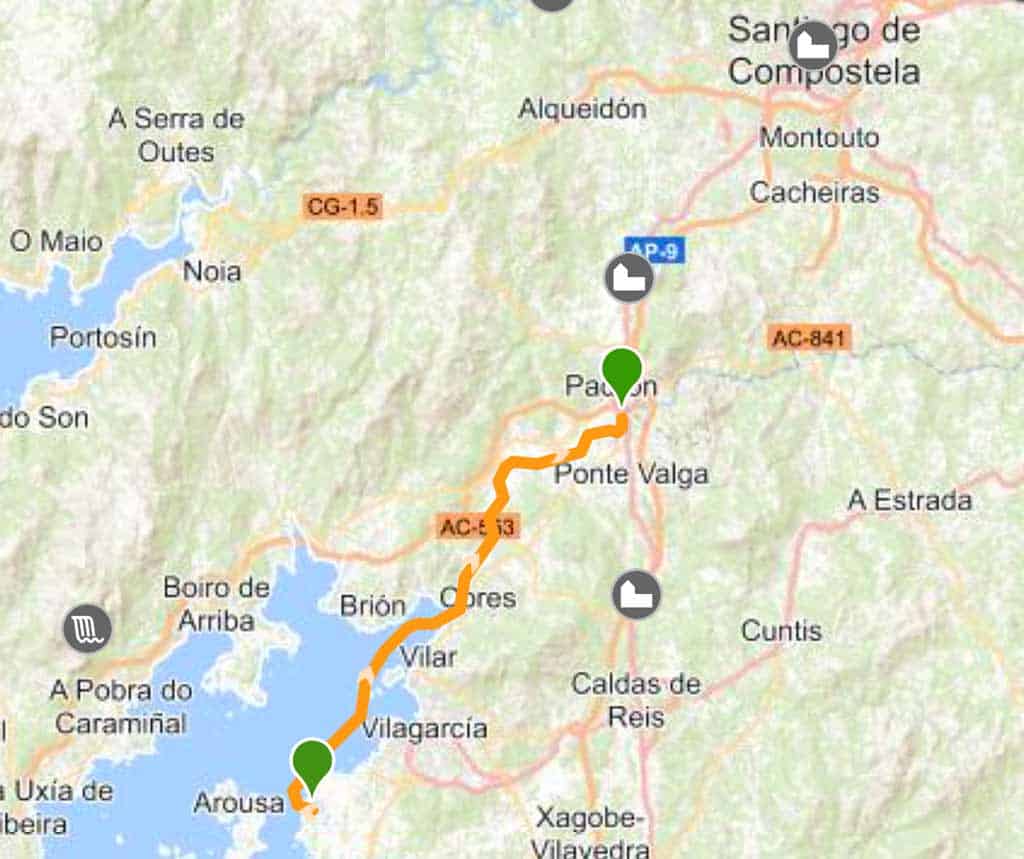
Of course, it is possible to walk this stage, but the vast majority of pilgrims choose to follow the Ruta Traslatio, the Maritime-Fluvial Jacobean Route, by boat. Officially recognised as a cultural and historical route, the journey crosses the Arousa Estuary and continues up the River Ulla to Pontecesures.
How you manage your day will very much depend on tide times, but whenever you make the journey, today will be memorable.

Stage Three : Vilanova de Arousa To Padron
Today’s stage is structured differently from previous days. While it is possible to walk the full 32 kilometres inland from Vilanova de Arousa to Pontecesures, most pilgrims travelling the Spiritual Variant begin their day in Vilanova de Arousa and continue by boat to Pontecesures.
The boat journey covers approximately 28 kilometres, travelling across the Arousa Estuary and ending at the river port of Pontecesures on the River Ulla. On arrival, you rejoin the Camino Portuguese on foot, crossing the ancient stone bridge over the river before walking the final kilometres into Padron for your onward journey to Santiago de Compostela.

Feeling overwhelmed with planning your Camino?
Instead of searching endlessly, take a look at my Camino Planning Workshops. I turned over a decade of experience into a library of 20+ hours of practical, short, easy-to-follow videos, answering every question a pilgrim could have and plenty you’ve not thought to ask yet!
The Traslatio Route – The Boat From Vilanova De Arousa
The Traslatio is about retracing the final part of a journey rooted in Camino tradition.
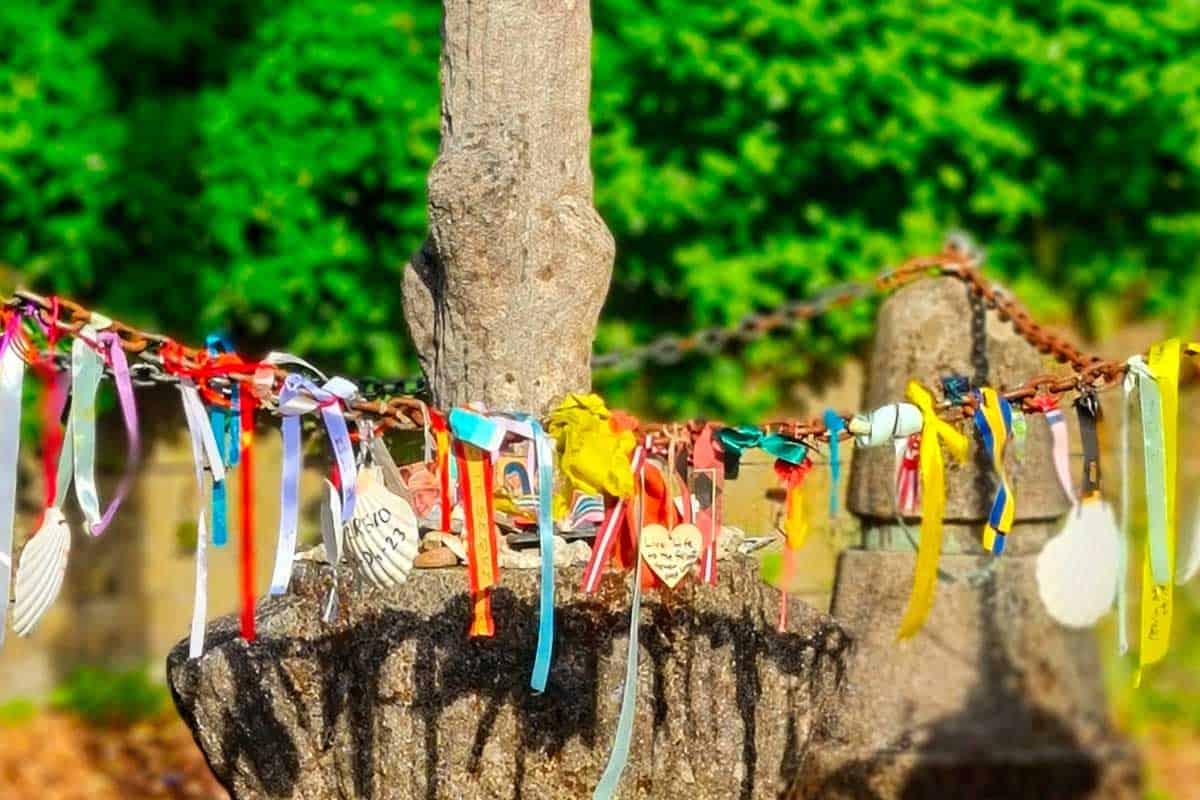
This fluvial pilgrimage is considered the only maritime Via Crucis, or Way of the Cross. Along the route, pilgrims pass 12 of the 17 stone crosses (cruceiros) and markers that commemorate key moments associated with the return of the Apostle’s remains to Galicia.
According to tradition, the Traslatio follows the final leg of the seven-day voyage made by Atanasio and Teodoro, the disciples who carried Saint James’s remains from Haifa (Palestine) to Iria Flavia, present-day Padron.
Recognised by the Xunta de Galicia in 1999, the route offers pilgrims the chance to complete part of their Camino by sea, connecting history, legend, and a maritime landscape in a way found nowhere else on the route to Santiago.
Top Tip: While the boat journey is recognised as an official part of the Camino, pilgrims must still have walked at least 100 kilometres in addition to the Traslatio route to qualify for the Compostela.
Booking Your Seat On The Boat
Three companies operate the Traslatio Route, and I recommend booking in advance. That said, it’s important to stay flexible, as schedules can and do change at short notice.
On one of our journeys, planned as a 7:00 am departure became a midday sailing. We’ve heard this isn’t uncommon so build a little buffer time into your itinerary.
Boat Operators In Vilanova de Arousa
Alvamar Náutica offers a scenic journey through the Arousa Estuary and up the River Ulla, with historical commentary along the way. Departures are available from both Vilanova de Arousa and Vilagarcía de Arousa.
Amare Turismo Náutico includes commentary on mussel farming, as well as passing islands from the Atlantic Islands National Park, and sails past several historic cruceiros.
La Barca del Peregrino completes the full 28 km journey crossing the Arousa Estuary and up the Ulla River, with historical narration about the Via Crucis cruceiros and the mussel platforms (bateas).
The Traslatio Route operates year-round, but it’s always best to check schedules in advance as availability may vary due to weather or demand.
Top Tip: Make sure to arrive early for your boat, and if you’re travelling during peak pilgrimage season, book ahead to secure your spot. And do expect the unexpected!

What You’ll See Along the Way
As you leave Vilanova, you’ll pass several square platforms floating out in the estuary. These are bateas, the mussel rafts that support Galicia’s famous shellfish industry. You’ll often see boats and workers out on the water as you pass.
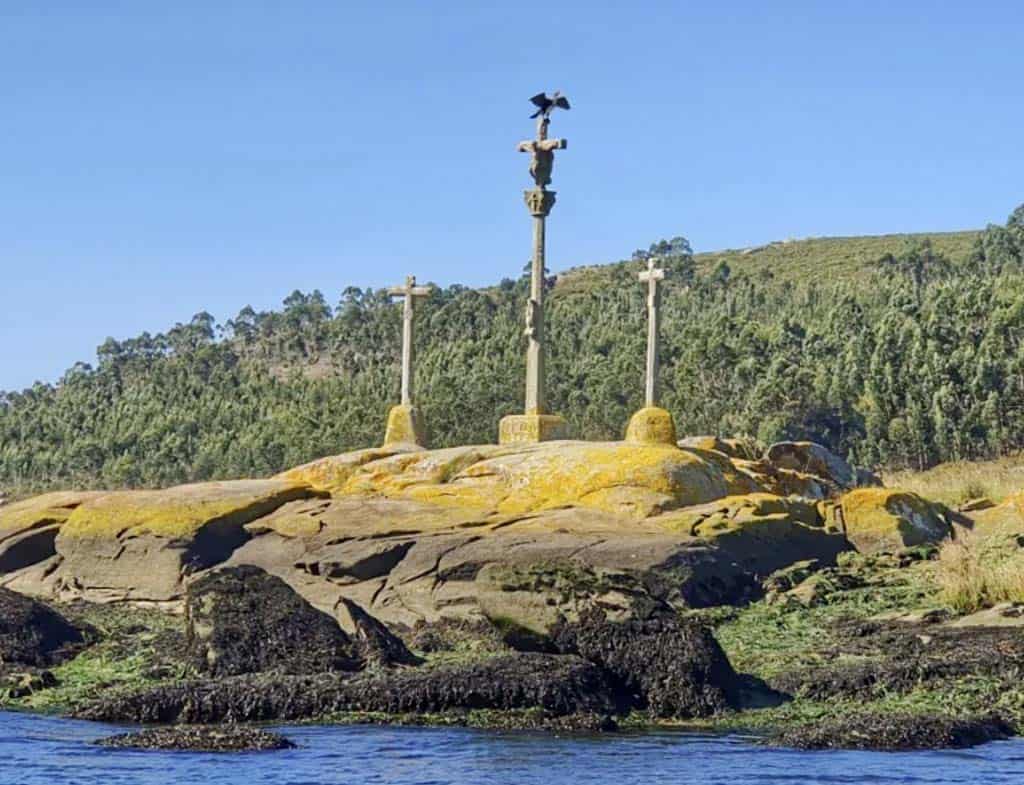
Leaving the estuary and entering the river, cruceiros begin to appear along the banks on both sides. Perhaps the best known is the group of three at Punte Patiño, on the left-hand side. Reminiscent of a Calvary, they are said to represent Saint James and his two disciples, Atanasio and Teodoro, who took his body on this journey from the Holy Land.
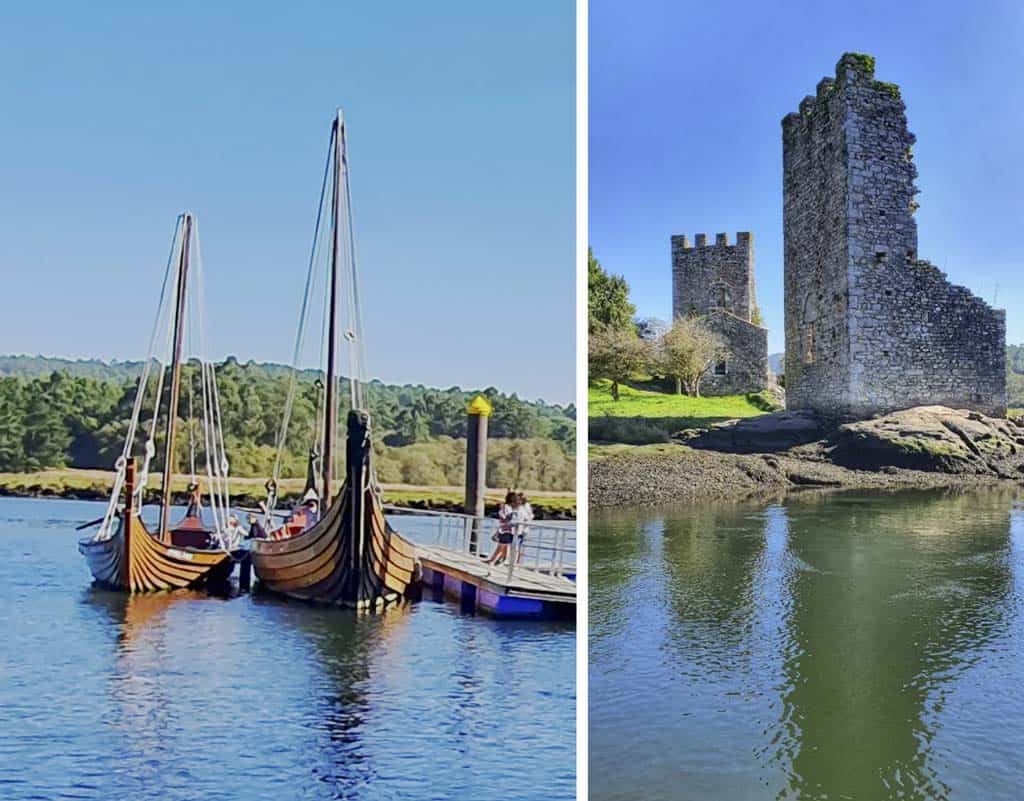
You’ll also pass Torre del Oeste in Catoira, the ruins of a 12th-century fortification built to defend the river against Viking attacks. If you’re travelling in early August, you may even spot Viking replica boats moored nearby for the annual festival.
The journey ends in Pontecesures, opposite the Finsa wood-processing factory, where you disembark and rejoin the Camino Portuguese on foot.
Walking From Vilanova De Arousa (32.7 km)
Leaving Vilanova on foot, the trail hugs the coastline and the Ulla river on the way to Pontecesures.
This really is the road less travelled, and with good reason; it is poorly marked in places, and after the initial beachy shoreline you’ll be walking on pavement next to the road, or the road shoulder.
On the other hand it gives you the option of visiting or even stopping at Vilagarcia de Arousa, as well as getting closer to the Torre del Oeste at Catoira.
If I’m totally honest, there isn’t a great deal to recommend the walking route, but the option is there should you need it, especially if all boats are full at the height of the season, or in the off-season. There is also a bus service a few times a day.
Herbon Detour (2.7 km)
Before you cross the Roman bridge over the River Ulla, you have the option of taking a 3 km detour to visit the Monastery of Santo Antonio de Herbón. While it adds some distance to your day, it’s an opportunity to experience a piece of Camino history and even spend the night in the traditional pilgrim albergue there. This is a good option if you arrive from the boat early in the morning.
Instead of turning left onto the bridge, turn right and take the underpass opposite the Repsol station. It will emerge on the rural Rua Cantillo, which will take you through A Barca and across a bridge to the Herbón monastery. To get there, simply follow the red arrows marked Herbón.
The monastery, established in 1396 by Franciscan friars, has been a spiritual centre for over six centuries. It has served as a retirement residence for friars, a missionary training school, and, most famously, the birthplace of Padron peppers. In the 17th century, monks returning from the Americas introduced the peppers to the monastery’s gardens. The rest as they say is history but maybe these famous tapas treats should be called Herbon Peppers rather than Padron!
A few years ago, the monastery faced a challenge when the last monks left, but recently, the Franciscan community has returned, reviving the site’s spiritual significance.


San Antonio De Herbón Pilgrim Hostel
The San Antonio de Herbón Pilgrim Hostel offers a very traditional Camino experience. If you have the time and energy, the detour is absolutely worth it, especially if you stay the night. The albergue reflects the true spirit of Camino hospitality, with a communal dinner and breakfast included. The cells very much remind me of a monastery stay along the Via de la Plata, with two beds per cell. If you’re lucky you may even have the chance to visit the monastery.

Want to learn more about the Camino? Then hop over to my Free Private Facebook Group | Walking The Camino De Santiago.
Pontecesures
The main Camino Portuguese trail follows the path from Caldas de Reis to the Roman bridge over the river Ulla. All pilgrims, except those heading to Herbon, cross the bridge and follow the yellow arrows toward the outskirts of Padron.
From the landing stage, carry on towards the Roman bridge but before you cross, the Traslatio has one last gift for you:
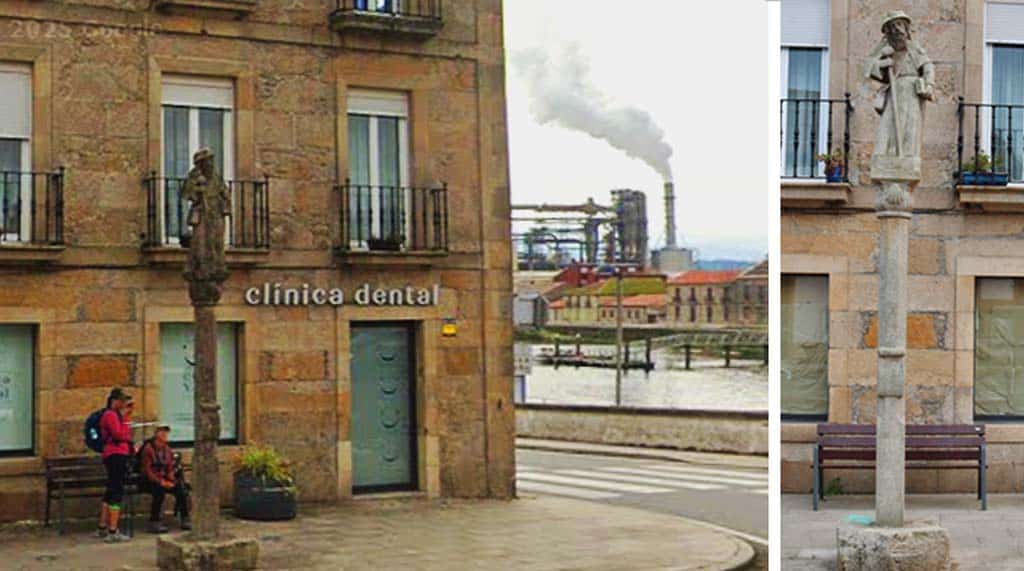
If you look to the right at the end of the street, you will see a figure of St James facing the road. This is the Fito Xacobeo, the last of the 17 figures of the Stations of the Cross that mark the path followed by the body of the Apostle James on his journey from Jerusalem to be buried in what would later be known as Compostela.
This statue, dressed in medieval attire, was put in place in 1965 and marks the end of the Via Crucis.
Puente Romano De Pontecesures
Walking over the Puente Romano de Pontecesures always feels like a major milestone for me. It marks the entrance to Padron and means that Santiago is close; just a day’s walk away.
This historic bridge spans the Ulla River, connecting the provinces of Pontevedra and A Coruña. While the current structure dates to the 12th century, it is believed to have been built on the site of an earlier Roman bridge. Strategically important along the Via XIX, the Roman road you will have been following for days, the town’s name may even derive from Pons Caesaris – Caesar’s Bridge.
A significant reconstruction in 1161 is attributed to Maestro Mateo, a renowned medieval sculptor and architect best known for his work on the Pórtico de la Gloria in the Cathedral of Santiago de Compostela.
There are several little café bars on the other side of the bridge; Casa Farrucan has particularly good Santiago cake! From here you are back on the Camino Portugués and following the more traditional arrows; marking the end of the Spiritual Variant trail.
You can spend the night in Pontecesures, if you wish to break your stage. There is an albergue and a few places to stay :

Pontecesures To Padron (2.3 km)
You’ll follow the Travesia Feira, which runs along the bank of the river Sar, taking you into Padron. As you get closer, you’ll pass a football field and then enter the Plaza de Abastos, a large market area, which can be full of stalls and vendors or even a fairground!
The Mercado de Abastos market hall offers local fruits, vegetables, fish, and meat, and is open Tuesday to Sunday from 08:00 to 14:30. There is also a Sunday market from 09:00 to 15:00 every week, filling the plaza with stalls offering clothes, fresh food, crafts, and local products – and importantly, freshly cooked churros!
On the corner in front of you is Restaurante Mundos; and without fail, the place I always stop before moving on; the Padron peppers here are excellent and they have gluten free beer!
Mexican restaurant Catriña by the Paseo is a new favourite among pilgrims who want something different, plus they offer wax stamps too.
Staying near the river you’ll enter the Paseo de Espolon, Padron’s open, shaded riverside park which is sometimes filled with activity and sometimes an oasis of calm.
From the wrought iron benches you can enjoy views of the Convento do Carmen monastery on the other side, or simply enjoy a rest before you go to find lunch, or find your bed for the night, or carry on towards Santiago de Compostela.

Padron And Saint James
Of all the places along the Camino de Santiago, Padron is perhaps the most significant and only town directly linked to the ministry of Saint James on the Iberian Peninsula.
Historically, Padron was known as Iria Flavia, a Celtic settlement located at the confluence of the Sar and Ulla Rivers. The Romans renamed it Iria Flavia in the 1st century AD, under the rule of Emperor Titus Flavius Vespasianus.
Religious tradition tells us that Saint James the Greater (Santiago el Mayor), son of Zebedee and one of Jesus’ closest disciples, lived and preached here during his missionary to the Iberian peninsular.
While there is little historical documented evidence to confirm his presence, the area’s enduring history, passed down through the centuries, ties him to Iria Flavia and tell us that he lived and preached both in the town and from the nearby Mount Medoñas. James’ mission was met with limited success among the local Celtic population, but his efforts became the foundation of the region’s Christian story.
After his martyrdom in Jerusalem in 44 AD, his disciples are said to have transported his body back to Iria Flavia. They moored their vessel to a large stone, the Pedron, which is now housed under the altar of the Church of Santiago de Padron. The town’s name itself derives from the Pedron.
Regardless of your faith, it’s impossible to walk through these lands without feeling the weight of the history and the footsteps which we follow.


Exploring Padron
Walking into Padron, you’d be forgiven for thinking it was a little dreary, especially on the approach from Pontecesures. However, the town has a pretty older centre with narrow streets worth exploring, and if you arrive on a Sunday, you might catch the Sunday market.
Padron’s incredible history makes it a fascinating place to stay, with plenty to keep you occupied. Whatever you do, even if just walking on, don’t miss the Church of Santiago.
1. Iglesia de Santiago (Church of Saint James)
Renowned for housing the Pedrón, the stone tied to the tradition of Saint James. Its opening hours can be tricky unless you plan to stay in town.
Top Tip: Visiting this church and getting a stamp allows you to claim your Pedronía, a certificate to say you have visited Padron’s historical church.
The Pedrónia certificate is available from the municipal albergue just below the monastery, so bring your credencial and a few euros in cash to pay for the protective tube. You can also get the certificate at the tourism office in town.
2. Monasterio do Carmo
Across the river from the Santiago church you can see the monastery on the other side.
The neoclassical building, built on top of living rock in the early 18th century, was first inhabited by monks belonging to a Carmelite order, then from 1836 to the Dominican Fathers, who are still present today.
If there is no mass in Santiago church, mass will likely be held here, but it is often closed.
3. Santiaguiño do Monte
Follow the signs up the stairs past the monastery walls, and a short but steep hike leads to this site with a chapel and stone cross, believed to be where Saint James preached.
4. Casa Museo de Rosalía de Castro
The former residence of Galicia’s most celebrated poet, this museum offers a glimpse into her life and works. It’s located near the railway station, so it’s a bit out of the way for pilgrims passing through.
5. Jardín Botánico Artístico (Artistic Botanical Garden)
Established in 1871, this garden is one of the oldest public gardens in Spain, and a lovely spot for a stroll while waiting for the Church of Santiago to open.

Where To Stay In Padron
Padron offers a range of accommodations, including albergue, hotels, and apartments. These days, I often prefer to walk on, as the walk from Vilanova de Arousa and the boat, is a short stage. And there is the added benefit of a shorter final day into Santiago de Compostela.
But if you’ve never visited Padron, you might prefer to spend the night and if you are looking for a great place to say these are my top picks :

What To eat In Padron
Padron is famous for the pimientos de Padron, little green peppers that are flash fried in olive oil and salted with coarse salt, and as the saying goes: Some are hot, some are not! Rule of thumb is that one in ten are chili pepper spicy while the rest are mild.
In my experience (having eaten many plates of Padron peppers!) there are very few hot ones, but if you find one, you’ll know! Gerry found one once so hot that he’s almost afraid to try them these days.
This area of Galicia is blessed with excellent seafood like pulpo, mussels and other shellfish, and a wide range of restaurants, cafés and bars serving food, but be warned that some don’t open for dinner until 20:00 and Sunday lunch is very popular!

Feeling overwhelmed with planning your Camino?
Instead of searching endlessly, take a look at my Camino Planning Workshops. I turned over a decade of experience into a library of 20+ hours of practical, short, easy-to-follow videos, answering every question a pilgrim could have and plenty you’ve not thought to ask yet!
Potential challenges on this stage
As this day starts with a boat trip, there are no real trail challenges, unless you are carrying on to another village or even all the way to Santiago. You do have some options when you reach Padron though :

Recommended Apps, Books And Websites for the Spiritual Variant
If you’re walking any stage of the Camino Portuguese, these apps, guidebooks, and websites are invaluable. Be sure to download or purchase them before leaving home:

Final Thoughts: Spiritual Variant From Vilanova de Arousa To Padron
When we walk to Santiago de Compostela, we walk to the tomb of the Apostle. Regardless of your faith, when you walk the way, you undertake one of the world’s greatest pilgrimages. And that pilgrimage owes its existence to the final journey of the remains of St James, to his resting place in Santiago.
The Spiritual Variant maybe a recent addition but the route is legendary. From ancient monasteries and even more ancient human settlements, this small Camino is a joy. And to add to its unique history, you can also end the route via the Traslatio.
The last stage is less of a walk and more of a journey. You do need to ensure you have your seat on the boat, but once you do, sit back and soak up the history of this very wonderful day.
Want to learn more about the Camino? Then hop over to my Free Private Facebook Group | Walking The Camino De Santiago.
Are You Walking The Portuguese Camino?
I’ve walked the Camino Portuguese many times, in all its forms, and I know that I’ll walk it again. If you’re walking from Porto to Santiago, I’ve created detailed daily guides packed with route tips, accommodation recommendations, and insights to help you along the way.
Here are some posts to help you plan your journey:
If you’re planning your Camino or are already on the trail, I’d love to hear about your experiences! Join my private Camino community on Facebook, share your stories, find inspiration and connect with fellow pilgrims.
Don’t Forget Travel Insurance
Whenever you travel, you should have great travel and medical insurance. None of us expect anything bad to happen, but in the event of an incident, you want to be sure that your insurance will cover you.
I’ve ended up in hospital in Peru, Indonesia, Portugal, Japan and Ireland. Every time my insurance took care of everything. I would never leave home without full and comprehensive insurance.
MondialCare : Due to increasing limitations, mainly due to age, we have recently switched to MondialCare for our travel insurance. We have taken an annual policy at a very reasonable cost that includes medical and other travel cover. There are no trip length limits and the upper age for cover is 84. For Camino walkers and travel in Europe they have a low cost Schengen policy with no age limit.
TrueTraveller : We have used this policy and were very happy with the cover, especially considering our ages and pre-existing conditions.
Globelink: We have used and recommended Globelink for years and not heard of any issues. They are a great choice for European and UK Residents.
Genki : This is an EU based company offering long term policies for nomads and travellers. Their monthly rates are very competitive for longer trips too.
Try Our Trip Planning Tools
Start here to find the best accommodation
Start here to find flights for your adventure
Start here to find the best sightseeing tours

Hey I’m Colleen. I’m married to Gerry, we’ve three fabulous kids and been living in France for almost two decades. I fell in love with Spain in the 1980s and I’ve walked 1000s of miles along the Camino de Santiago. Now we’re exploring and walking the world and I can’t wait to share what we’ve learned!