
Home > Camino Ingles Guide > Stage 4 : Hospital de Bruma to Sigueiro
Hospital de Bruma to Sigueiro : Practical Walking Guide for Stage 4 Of The Camino Ingles
Some of my links may be affiliate links. If you make a purchase, I might earn a small commission at no cost to you. See our Privacy Policy for details. And this post was crafted with care and occasional typos by Colleen (and not AI)
Yeah! Today is mostly downhill, and the toughest climbs are behind us; for now at least! This stage of the Camino Ingles is a welcome change and Santiago de Compostela is now less than 40 km away.
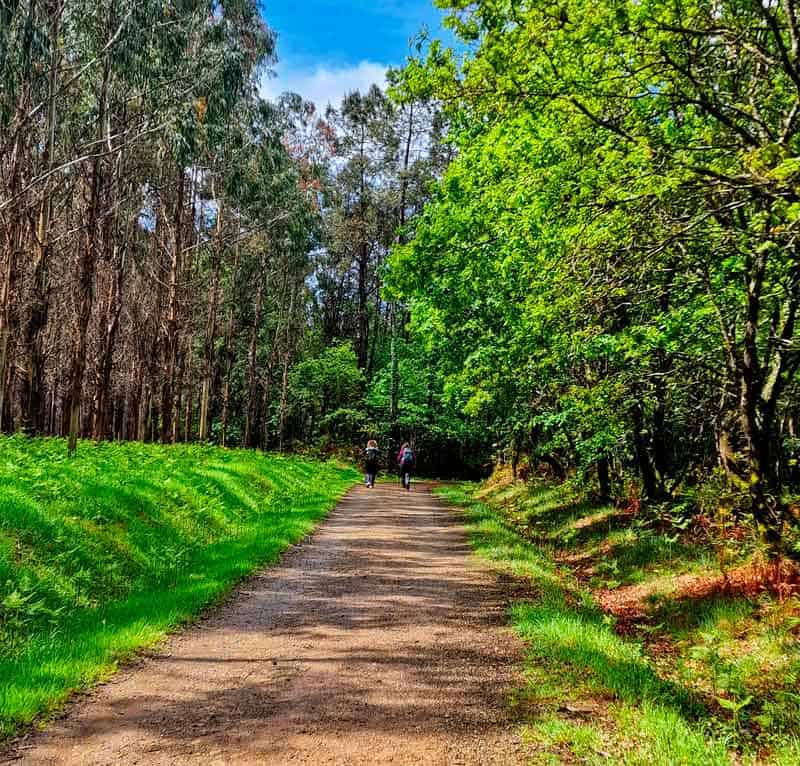
As with much of the English Way, there’s a fair bit of road walking between Hospital de Bruma and Sigueiro, but there are also some very pretty forest trails to enjoy.
You’ll also face a route choice today: follow the new trail beside the motorway or stick to the older route, which has even more tarmac. Neither is perfect, but I’ll explain why later. Services are sporadic, but they do exist and we found a couple of excellent coffee stops. And if you prefer a slower pace, you have the option to split this stage.
After more than a decade of walking the Camino, I know how good it feels to finally have a day without a big climb! The trail starts to feel busier as more pilgrims come together as we walk closer to Santiago.

Walking the Camino Ingles from Hospital de Bruma to Sigueiro
Before walking the Camino Inglés, I had read a lot about recent route changes; recent as in the last few years. There’s been plenty of debate, with some pilgrims preferring the new route while others continue to seek out the old path, even though it’s no longer marked.
Personally, I like to follow the arrows. One of the things I love about the Camino de Santiago is how well-marked it is, I can put away my maps and just walk. However, there have been a few exceptions on the Camino Inglés, and today is one of those days. Around kilometre 18, you’ll have a choice to make.
And as always, I recommend having breakfast before setting off. We stayed at Albergue Lorenzo, where there are vending machines, but it was several kilometres before we found coffee. There are a couple of food options along the way, but very few services until you reach Sigueiro, so plan accordingly.


Want to learn more about the Camino? Then hop over to my Free Private Facebook Group | Walking The Camino De Santiago.
Take Two Days And Break The Stage At O Outeiro or A Calle
Today is a rather straightforward 24 kilometre walk. Many folks are happy to walk this stage in its entirety but if you prefer the idea of a gentle day, there are options that allow you to break the stage.
I’ll mention as we walk though the day but your options include :
Towns and Villages Between Hospital de Bruma to Sigueiro
While Hospital de Bruma has an excellent bar/restaurant, and the pilgrim dinner is fantastic, it doesn’t open until 9:00 am. If you’re looking for breakfast before setting off, you’ll need to be self-sufficient.
We stayed at San Lorenzo Albergue, which has vending machines for hot drinks but it’s worth considering your options before you leave, as there are no services in Bruma.
Both albergue in Hospital de Bruma are directly on the Camino, so finding the arrows is easy. The distances below assume you’re starting your walk from Bruma.
Walking from O Meson do Vento
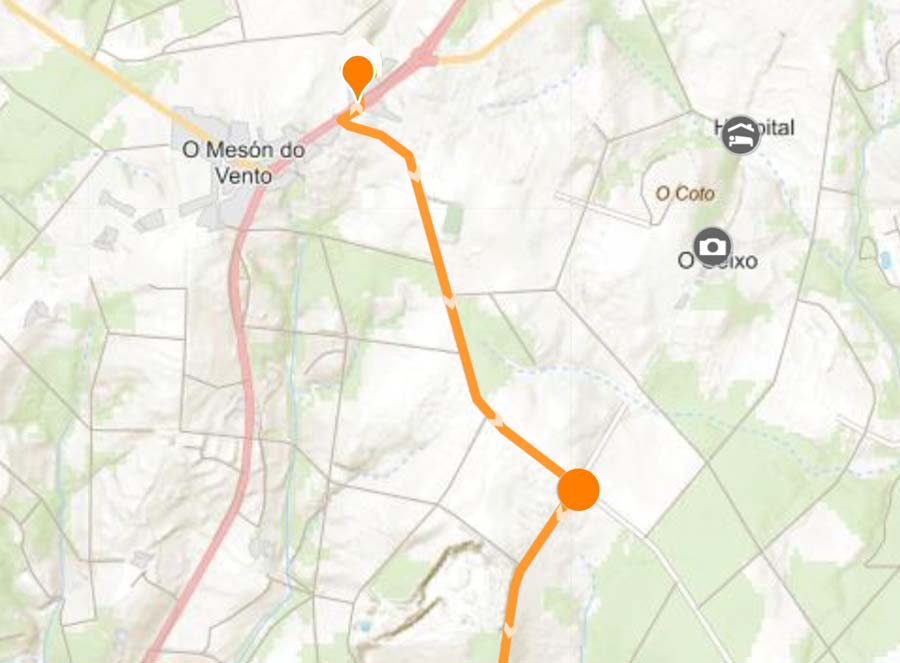
If you stayed overnight in O Meson do Vento, you’ll only add around 300 metres to your day. It’s an easy walk from town to rejoin the Camino just after O Siexo. It’s an easy walk out of the town and you can use google maps to direct you back to the Camino.
Cabeza de Lobo (3.5 km)
Cabeza de Lobo sits at around the 3.5-kilometre mark from Hospital de Bruma. I’ve seen this tiny hamlet referred to as Cabeza de Lobo, Ordes, O Porto, and O Castro, but whatever name it goes by, you’ll know you’ve arrived when you spot the dinosaur!
There’s a café here, Bar Uzal. It was closed when we passed through, but it could be an option if you’re walking later in the day.
Just beside the bar, there’s a stone statue of Santiago, but to be honest, we were distracted by the dinosaur and the tractor roller-coaster. I tried to find out why this quirky collection exists but found nothing. I suppose it’s just one person’s folly, and it definitely made us smile!
I’ve since seen photos of the dinosaur mid-meal, chomping on a model person, there was no trace of that unfortunate victim when we passed by!

A Rua (3.7 km)
The walk into A Rua follows quiet country roads with a stretch of lovely forest trail. Unfortunately, we had more rain for most of the morning, so we were very happy to take a break at Café Bar Novo.
I’m pleased to report that the coffee was excellent and we probably lingered longer than we should. But the rain was coming down and there was little temptation to move on!
Just as you leave the café you’ll see the Igrexa de San Paio de Buscás, an 18th-century parish church with a rather colourful little statue.
San Paio (Saint Pelayo), is a popular saint in Galicia, you’ll see a few San Paio churches along the Camino Frances too. He was a young Christian martyr from the 10th century although this statue is dated 1737.

O Outeiro (2.3 km)
The trail continues along country roads, with occasional detours onto softer trails. You’ll pass through a small forested area and along quiet country paths before eventually arriving in O Outeiro.
Along the way, beside the granite Camino marker at 31.374, there’s a sign for a Casa Rural and restaurant: Anton Veiras. If you’re looking to break this stage, there are a couple of good options here in O Outeiro:
This is another lovely section, passing through tiny hamlets on quiet country roads, with gentle diversions onto softer trails. We really enjoyed this part of the walk!
Top Tip : My app had warned us that there were confusing (purple) arrows leaving Outeiro but I have to say we didn’t find this; however it’s worth noting the advice and keep a look out for the yellow arrows.

A Calle (2.3 km)
Continuing on, you’ll follow country roads once again, passing through tiny hamlets and weaving between fields and forests, before the arrows guide you into A Calle.
Beyond A Calle, there are no services until Sigueiro, so you’ll definitely want to stop at Bar O Cruceiro. But be warned, almost every pilgrim stops here, so expect it to be busy!
That said, this is a fantastic bar, the food is excellent and the atmosphere is great. We ended up lingering here for some time, chatting with many of our new Camino friends. Today I knew I’d be catching up with a Camino buddy, the lovely Nidarosa from Somewhere Slowly. So I was very happy to hear my name called from across the bar!
Top Tip: You’ll need to leave your rucksack and poles outside the bar. Do not leave valuables behind and if you’re travelling with someone else, buckle your waist straps together; this makes it much harder for someone to grab the wrong pack by mistake.
There is an option to stay in A Calle,

A Baxoia : New Route Option (6.3 km)
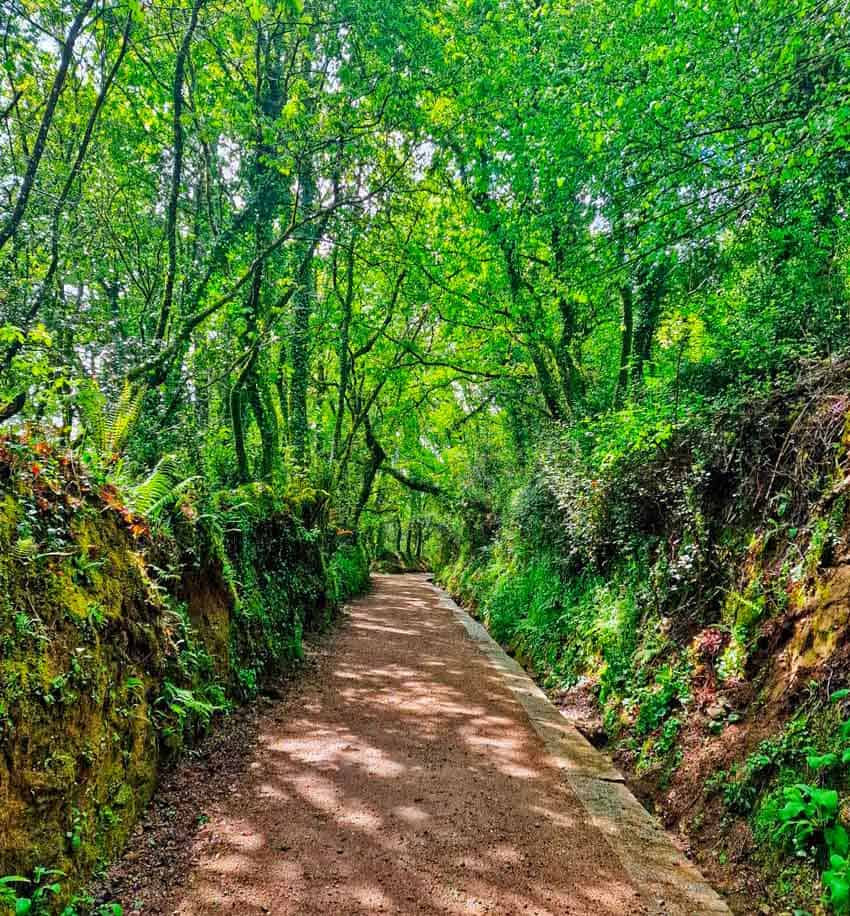
The walk from A Calle is rather lovely. The sun came out for us, and we meandered through small hamlets, with plenty of opportunities to walk on softer trails.
At A Baxoia, you’ll face a route choice, and another contentious change from the original Camino Ingles. The arrows lead you across the AP-9 motorway, and after this, you have two options:
Neither option is perfect. The old route is a long, straight tarmac road with little shade, while the new route, though safe and separated from traffic, runs close to the motorway. There are pros and cons for the New Route :
Pros
Cons

Since we chose the old route, I can’t directly compare the two, but speaking with other pilgrims and reading other blogs, it seems most people found the new route a tad miserable.
Interestingly, as we walked toward the old route, we stopped to ask a local couple if we were on the right path. They confirmed that we were and added that the old route is nicer than the new one. Even the locals seem puzzled by this route change..
I’m still undecided on which is better as both have pluses and minuses. However, if you need water or some shade or you prefer a trail to tarmac, or if you’d rather stick with the arrows then take the new route but be prepared for a little traffic.
Top Tip : The old route is not a soft trail. If you choose to take it, be aware that you’ll be walking on tarmac, though it is a quiet country road.


Old and New Routes Merge (5 km)
Regardless of which route you choose, both paths merge on the outskirts of Sigueiro at around the 23-kilometre mark.
Sigueiro is a reasonably sized town with all services, so your final walk of the day will take you through its urban outskirts. There’s a short section through a pretty park, though when we passed, it was closed due to a local cycling race. Normally, however, the route is well-marked and easy to follow.
Want to learn more about the Camino? Then hop over to my Free Private Facebook Group | Walking The Camino De Santiago.
Sigueiro (1.6 km)
When Gerry and I walk, we have a rule upon arrival: bar or bed. If we find a bar first, we stop for a drink. If we find our bed first, we check in. Thankfully, after 12 kilometres without refreshments, we stumbled upon a wonderful bar just a few steps from our albergue.
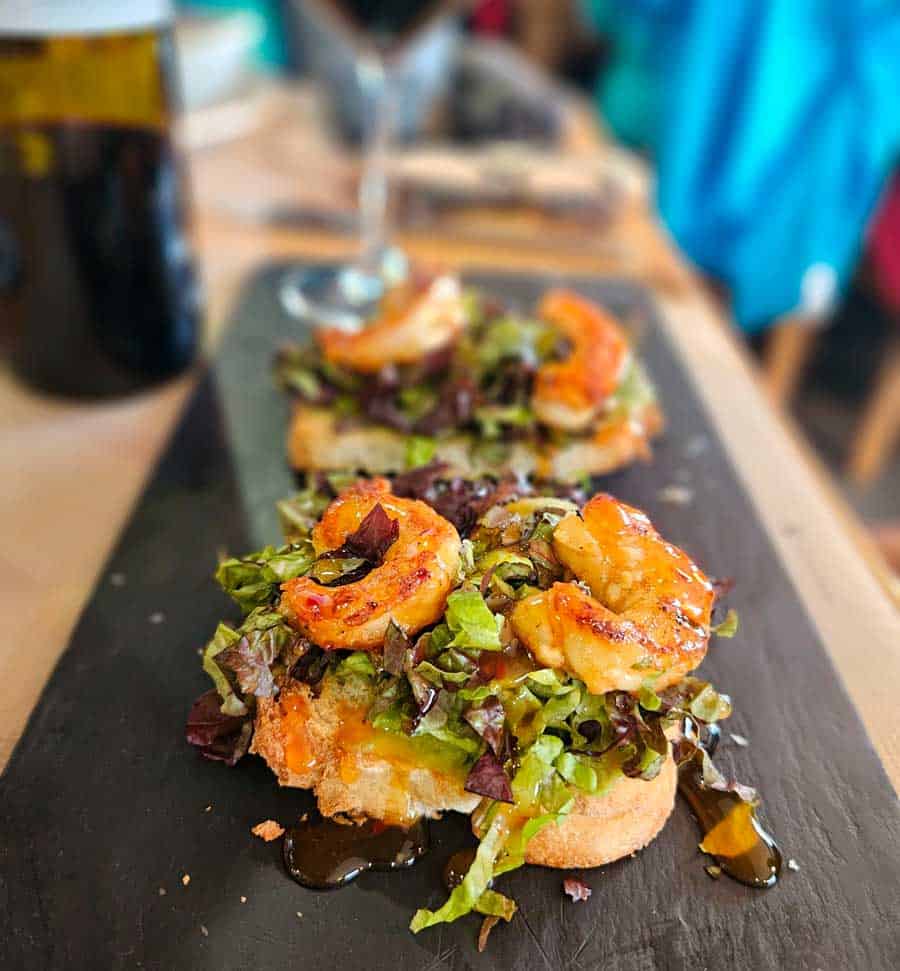
Cerveceria Valle is right on the Camino, and while it looks simple, it delivered an excellent lunch. And they had gluten-free beer, served gluten-free tapas, and even had a gluten-free menu—a 5-stars in my book!
Top Tip : Sigüeiro is written with a diaeresis (dots) over the letter “ü”. In Spanish, this means that when a “u” follows a “g” and is then followed by a vowel, it must be pronounced—similar to an English “w”.
Sigüeiro is a small functional agricultural town but it has a strong Camino history. It has long been an important stopping point on the Camino Ingles, providing rest and services for pilgrims making their final walk into Santiago de Compostela.
In medieval times, the town likely had pilgrim hospitals, similar to those found in nearby Bruma, which have been documented since at least 1175. These hospitals were typically run by religious orders, local parishes, or confraternities, offering shelter, food, and medical care to weary pilgrms.
Sigüeiro’s 14th-century bridge over the River Tambre was built under Fernán Pérez de Andrade; the same Fernán from Ponte de Porco. As a powerful Galician noble, he was responsible for building several key bridges along the Camino Ingles, making safe crossings possible for medieval pilgrims.
I like this town. It feels like a real working town rather than a tourist attraction, and as pilgrims we were made very welcome. It was a good end to a good day.

Where to Stay In Sigueiro
There’s a range of accommodation in Sigüeiro. We chose to stay at Albergue Camino Real, a popular option offering both private rooms and bunk beds.
Top Tip : If you book private rooms for a group, you may be placed in different buildings. My sister was in the albergue, I was down the street, and our friends were across the road. Everything is very close, so it wasn’t an issue, but if you need rooms together, mention it when booking.
Top Tip : Even if you’re not staying at Albergue Miras, go to their restaurant for dinner. The food was excellent, but don’t over-order as the portions are large!

Recommended Apps, Books & Websites for the Camino Ingles
If you’re walking from Ferrol to Santiago de Compostela then there are apps, guidebooks, and websites which will be invaluable. Be sure to download or purchase them before leaving home:
Want to learn more about the Camino? Then hop over to my Free Private Facebook Group | Walking The Camino De Santiago.
Final Thoughts on the Camino Ingles between Hospital de Bruma to Sigueiro
I really enjoyed the walk from Hospital de Bruma to Sigüeiro. The route winds through several little villages and whilst services are sparse, we made the most of the two cafés we found. We enjoyed both the breaks, the food and the company of fellow pilgrims along the way.
I was especially grateful for the opportunities to get off the road and onto softer trails, though as always on the Camino Inglés, there’s still plenty of tarmac. And if 24 kilometres feels like too much, there are several places to break the stage.
Overall, this was another wonderful day of walking through rural Galicia; complete with rain! We really enjoyed Sigüeiro, and our evening meal at Restaurante Miras was the icing on the cake. It felt like everyone we’d met along the way had gathered there, and with Santiago just a day away, there was definitely a festive atmosphere.
Are You Planning to Walk the Camino Inglés? Here’s Your Stage-by-Stage Guide
This post is part of my comprehensive Camino Inglés series, covering everything you need from the starting point in Ferrol to your arrival at the Cathedral of Santiago de Compostela.
Every post includes detailed tips, route options, practical advice and accommodation options. And if you’d like more then join my private Walking The Camino Facebook group.
Don’t Forget Travel Insurance
Whenever you travel, you should have great travel and medical insurance. None of us expect anything bad to happen, but in the event of an incident, you want to be sure that your insurance will cover you.
I’ve ended up in hospital in Peru, Indonesia, Portugal, Japan and Ireland. Every time my insurance took care of everything. I would never leave home without full and comprehensive insurance.
MondialCare : Due to increasing limitations, mainly due to age, we have recently switched to MondialCare for our travel insurance. We have taken an annual policy at a very reasonable cost that includes medical and other travel cover. There are no trip length limits and the upper age for cover is 84. For Camino walkers and travel in Europe they have a low cost Schengen policy with no age limit.
TrueTraveller : We have used this policy and were very happy with the cover, especially considering our ages and pre-existing conditions.
Globelink: We have used and recommended Globelink for years and not heard of any issues. They are a great choice for European and UK Residents.
Genki : This is an EU based company offering long term policies for nomads and travellers. Their monthly rates are very competitive for longer trips too.
Try Our Trip Planning Tools
Start here to find the best accommodation
Start here to find flights for your adventure
Start here to find the best sightseeing tours

Hey I’m Colleen. I’m married to Gerry, we’ve three fabulous kids and been living in France for almost two decades. I fell in love with Spain in the 1980s and I’ve walked 1000s of miles along the Camino de Santiago. Now we’re exploring and walking the world and I can’t wait to share what we’ve learned!